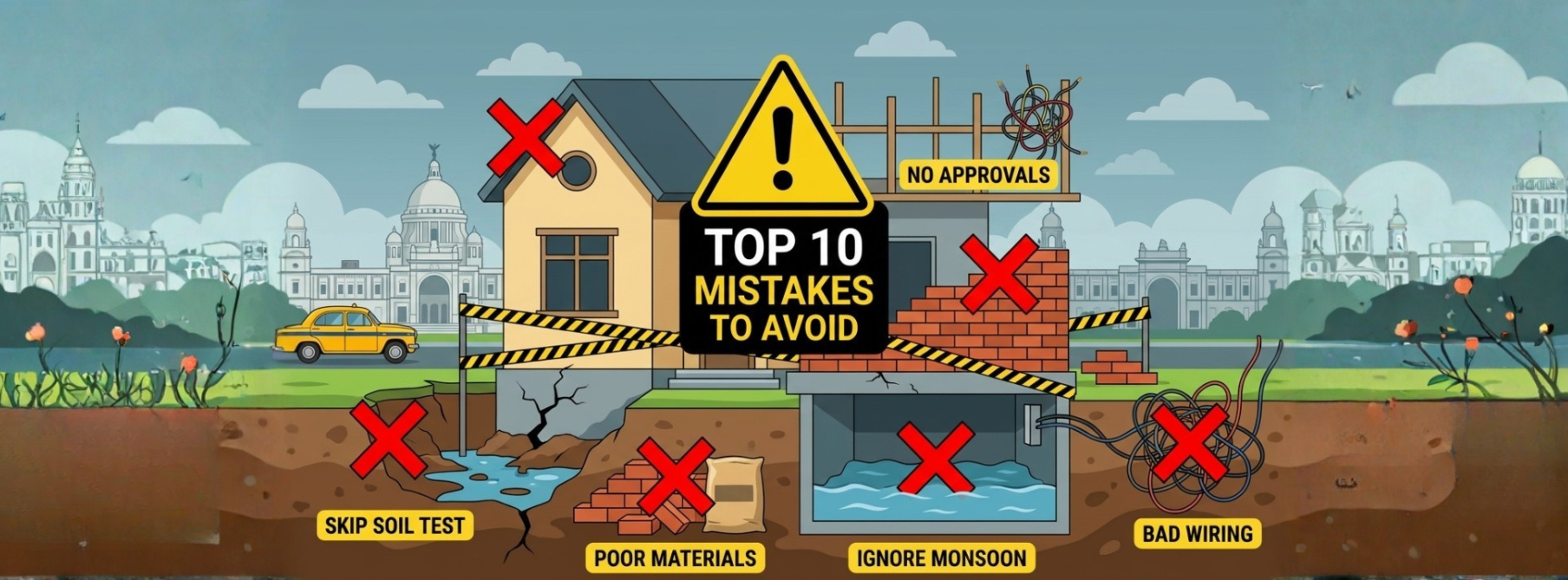
Top 10 Mistakes to Avoid While Building a House in Kolkata (2026 Guide)

Building a house is a once-in-a-lifetime project for most people. But small mistakes during construction can lead to massive cost overruns, poor quality, and long-term maintenance problems. Here are the top 10 mistakes Kolkata homebuilders make — and exactly how to avoid them.

1. Starting Without Proper Planning

Many people begin construction without a clear plan — no defined budget, no material planning, no timeline. The result is cost overruns and delays that compound at every stage. Fix your budget, floor plan, and material specs before a single brick is laid.

2. Choosing the Wrong Contractor

A contractor can make or break your project. Low quotes often hide underskilled labour, poor supervision, and hidden costs. Always verify experience, check past projects, and get at least 3 written quotes before signing.

3. Ignoring Soil Testing

Soil quality directly affects foundation strength. Kolkata’s low-lying areas have highly variable soil bearing capacity. Skipping soil testing can lead to cracks, differential settlement, and foundation failure. Cost of soil test: ₹8,000–₹15,000. Savings: potentially lakhs.

4. Using Low-Quality Materials

Trying to save money with cheap materials is a false economy. Poor cement means a weak structure. Low-grade steel creates safety risks. The cost of repair or rebuilding always exceeds the original saving. Always buy from verified dealers with genuine brands.

5. Not Comparing Material Prices

Prices vary significantly across dealers in Kolkata. Cement difference across dealers: ₹20–₹40 per bag. Steel difference: ₹3–₹5 per kg. Not comparing can increase your total material cost by 10–15%. SmartStructure helps you compare instantly.

6. No Waterproofing Planning

Kolkata’s climate makes waterproofing non-negotiable. Terrace leakage, wall dampness, and mould issues are the top post-construction complaints. Waterproofing costs far less when planned upfront than as a retrofit. Always include it in your initial budget.

7. Overdesigning the Structure

Complex designs significantly increase cost — extra columns, fancy layouts, and unnecessary architectural features add both material and labour cost. Keep your design simple and structurally efficient. Every deviation from a simple box costs more.

8. Changing Plans Mid-Construction

This is one of the single biggest cost drivers in residential construction. Rework, material wastage, and project delays caused by mid-construction changes can add 20–30% to your total cost. Finalise everything — floor plan, finishes, electrical layout — before work starts.

9. Poor Site Supervision

Lack of regular supervision leads to material wastage, low-quality execution, and in some cases theft or misuse of purchased materials. Either hire a site supervisor or personally visit the site daily during active construction phases.

10. Ignoring Legal Approvals

Skipping KMC approval to save time or money creates serious problems — legal penalties, construction stoppage, difficulty getting utilities, and problems at resale. There are no shortcuts here. Get your plan sanctioned before breaking ground.

Real Cost Impact of These Mistakes

Mistake Typical Cost Impact
No planning or budget +20% total cost
Wrong or cheap materials Poor durability + repair costs
No price comparison +10–15% material cost
Mid-construction changes +20–30% total cost
No waterproofing ₹2–5 lakh in repairs within 5 years

Kolkata-Specific Advice

  • Focus on waterproofing — Kolkata’s monsoon is unforgiving
  • Use moisture-resistant materials wherever possible
  • Work with experienced local contractors who understand Bengal soil and climate conditions

Pro Tips

  • Plan your budget with a 10–15% buffer for surprises — they always come
  • Track expenses weekly against budget — not monthly
  • Always verify suppliers and buy from SmartStructure-verified dealers

🏗️ Final Thought

Building a house is not just about spending money — it is about making the right decisions. Avoiding these 10 mistakes can save you lakhs and ensure a strong, durable home that stands for generations.
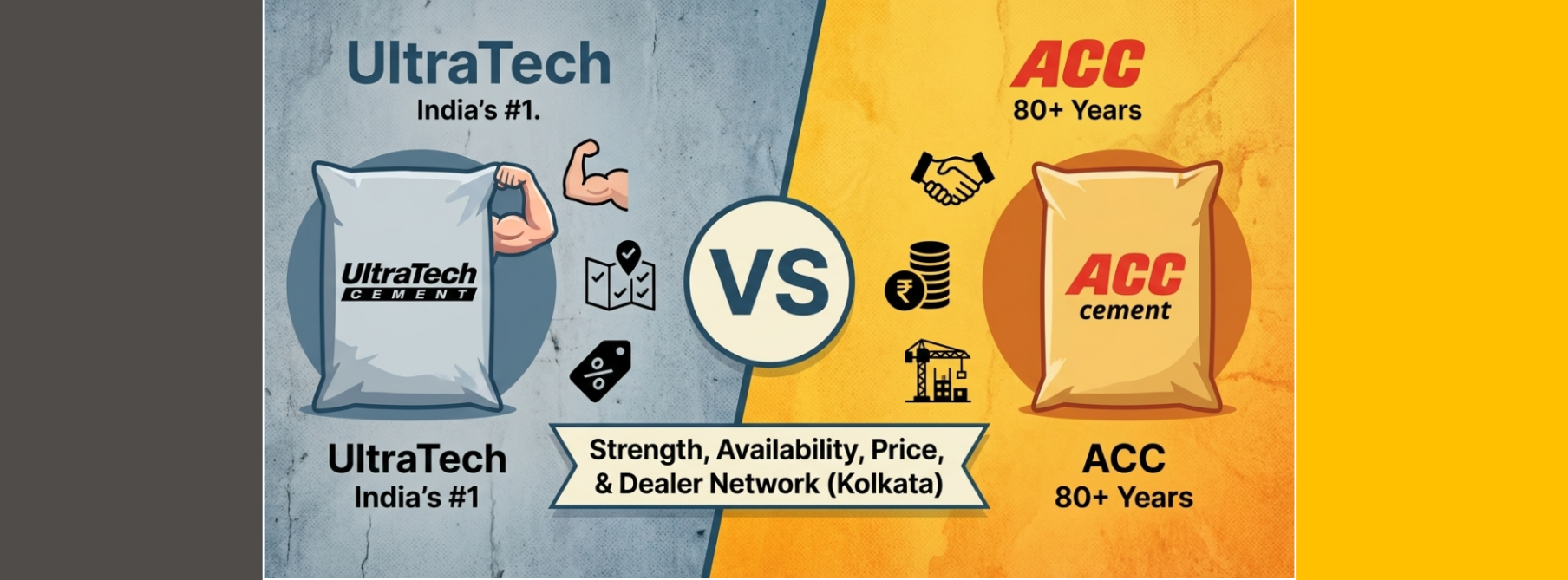

UltraTech vs ACC Cement — Which is Better for Construction?

UltraTech and ACC are India’s two largest cement producers. Both offer quality products — but there are meaningful differences in product range, pricing, dealer availability in Kolkata, and suitability for specific applications.

Brand Overview

UltraTech Cement is India’s largest cement manufacturer (part of Aditya Birla Group) with over 120 million tonnes annual capacity. ACC Cement (part of Holcim Group) has over 80 years of history and is known for consistent quality.

Product Range Comparison

Parameter UltraTech ACC
OPC 53 Grade ✅ Available ✅ Available
PPC ✅ UltraTech PPC ✅ ACC PPC
PSC (Slag) ✅ UltraTech Concrete+ ✅ ACC Suraksha PSC
White Cement ✅ White Cement ❌ Limited
Kolkata Dealer Network Very wide Wide
Avg. Price (50kg bag) ₹360–₹390 ₹355–₹385

Performance in Kolkata’s Climate

Both brands perform reliably in Kolkata’s humid conditions. For foundation work in low-lying areas, ACC Suraksha PSC is particularly well-regarded by structural engineers. For general residential construction, both OPC 53 grades are equivalent in performance.

Which Should You Choose?

For most residential construction in Kolkata, either brand is appropriate — focus on grade selection over brand. If your site is in a low-lying area with high water table, ask your structural engineer about PSC options from either brand. If price is a factor, shop dealer-to-dealer as prices vary by ₹10–₹25 per bag even within the same brand.

💡 Always check the manufacturing date on cement bags. Cement older than 3 months loses strength rapidly. Buy only fresh stock from verified dealers.

Why Do Cracks Appear in Walls — and How to Prevent Them?

Cracks in walls are one of the most common — and most misunderstood — issues in Indian residential construction. Most are harmless. Some are not. This guide helps you tell the difference and prevent both.

Types of Wall Cracks

Crack Type Appearance Severity Cause
Hairline cracks Very fine, <0.5mm Low — cosmetic Plaster shrinkage, thermal movement
Settlement cracks Diagonal at corners Medium Differential foundation settlement
Structural cracks Wide, through-wall High — urgent Foundation failure, overloading
Moisture cracks Irregular, damp patches Medium Water ingress, leakage

Most Common Causes in Kolkata Homes

  • Poor curing: Cement plaster must be cured with water for minimum 7 days. Skipping this causes shrinkage cracks as the plaster dries too fast.
  • Foundation issues: Kolkata’s soft soil requires proper foundation design. Inadequate depth or width causes settlement cracks.
  • Thermal expansion: Temperature changes cause walls to expand and contract. This is normal but must be accommodated with control joints in long walls.
  • Substandard materials: Excessive water in concrete (high water-cement ratio) causes cracking on setting. Always follow mix ratios.
  • Overloading: Placing heavy loads (water tanks, AC units) on walls not designed for them can cause structural cracking.

Prevention Checklist

  • ✅ Soil test before foundation design
  • ✅ Proper concrete mix ratios (do not add excess water)
  • ✅ 7-day wet curing of all plaster and concrete
  • ✅ Control joints in walls longer than 6 metres
  • ✅ Waterproof parapet walls to prevent water entry
  • ✅ Use only verified quality cement and aggregates

How to Waterproof Your Roof Properly — Complete 2026 Guide

Kolkata receives over 1,600mm of annual rainfall — most of it concentrated in June to September. A properly waterproofed roof is not optional. This guide covers every method, cost, and which works best for your situation.

Why Roof Waterproofing Fails

The most common reason waterproofing fails is not the product — it is application. Waterproofing applied over dirty, damp, or cracked surfaces will fail within 1–2 monsoons regardless of brand. Surface preparation is 70% of the job.

Waterproofing Methods Compared

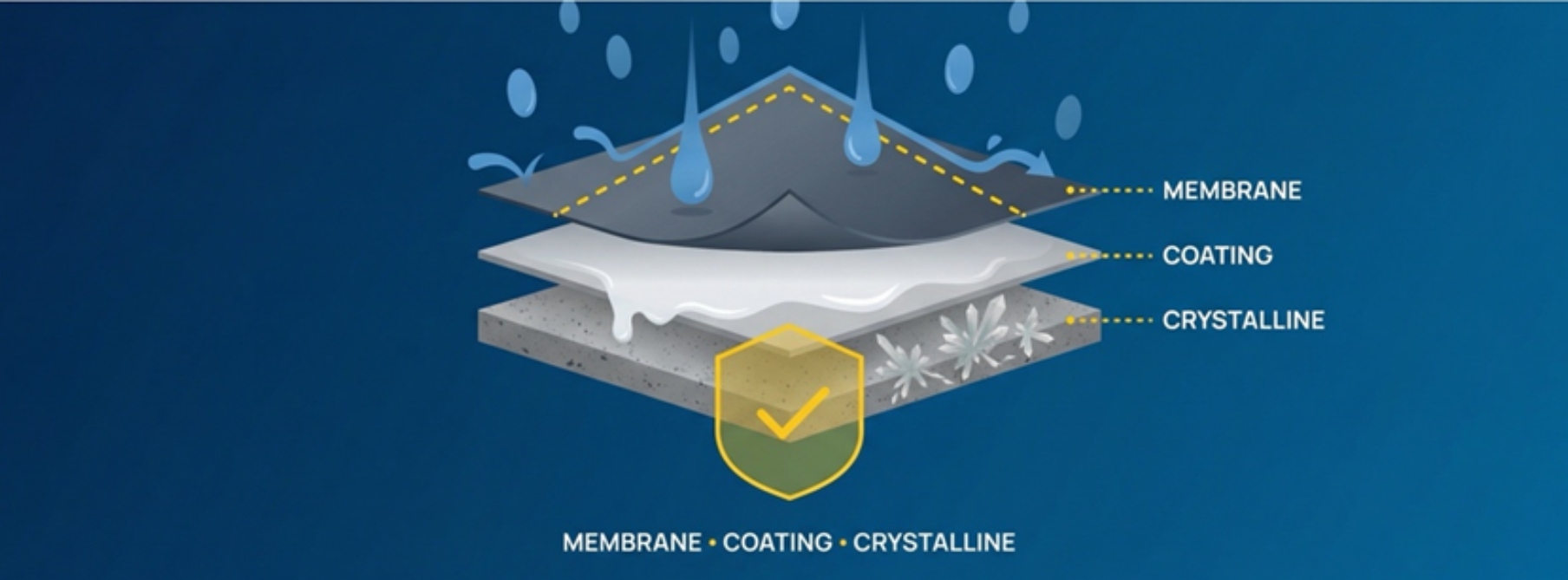
Method Cost (per sq.ft.) Life Best For
Bituminous membrane ₹60–₹90 10–15 years Flat RCC roofs
Cementitious coating ₹25–₹45 5–8 years Toilets, terraces, basements
Liquid applied membrane ₹50–₹80 8–12 years Complex shapes, parapet walls
Crystalline waterproofing ₹70–₹100 Lifetime Water tanks, basements
Chinese tiles (Madras terrace) ₹35–₹55 15–20 years Traditional Kolkata roofs

Step-by-Step Roof Waterproofing Process

  1. Inspect and repair: Fill all cracks with polymer-modified mortar. Allow to cure for 3–5 days.
  2. Clean thoroughly: Remove dust, laitance, and any oil. A clean surface is essential for adhesion.
  3. Apply primer: Bituminous primer for membrane systems; bonding agent for cementitious systems.
  4. Apply waterproofing: Follow manufacturer specification — number of coats, wet film thickness, overlap at joints.
  5. Protect the waterproofing: A protective screed or tiles prevents UV damage and foot traffic damage to the membrane.
  6. Check drainage: Ensure rainwater outlets are clear and sloped correctly — minimum 1:80 fall.

💡 Kolkata-specific tip: Treat parapet wall joints and slab-to-parapet junctions as a priority — these are the most common entry points for water in Kolkata homes.

Construction Cost Per Sq Ft in India 2026 — City-Wise Comparison

How much does it cost to build a house per square foot across India in 2026? Cities vary dramatically — and understanding why helps you budget smarter regardless of where you build.

City-Wise Construction Cost 2026

City Economy Standard Premium
Kolkata ₹1,400–₹1,600 ₹1,800–₹2,100 ₹2,500–₹3,200
Mumbai ₹1,900–₹2,200 ₹2,500–₹3,000 ₹3,500–₹5,000+
Delhi / NCR ₹1,700–₹2,000 ₹2,200–₹2,700 ₹3,000–₹4,200
Bangalore ₹1,600–₹1,900 ₹2,100–₹2,600 ₹3,000–₹4,000
Chennai ₹1,500–₹1,800 ₹1,900–₹2,300 ₹2,700–₹3,500
Hyderabad ₹1,500–₹1,700 ₹1,900–₹2,200 ₹2,600–₹3,400
Pune ₹1,600–₹1,900 ₹2,100–₹2,500 ₹2,900–₹3,800

Why Kolkata Has Lower Construction Costs

Kolkata benefits from lower labour rates, proximity to Bengal’s brick and sand supply chains, lower land and logistics costs compared to western metros, and a large pool of skilled construction labour. This makes it one of the most cost-effective major cities to build in India.

What Drives Cost Variation Within a City?

  • Quality grade: Standard vs premium finishes can double per-sq-ft cost
  • Number of floors: G+2 costs more per sq ft than G+1 due to structural requirements
  • Zone: Central Kolkata vs Rajarhat — logistics and labour vary
  • Material sourcing: Buying direct from dealers vs through contractors can save 8–15%