Building your dream home is one of the biggest investments of your life. From choosing the right bricks and TMT steel to selecting sand, aggregates and cement, every construction material plays an important role in the strength and durability of your house.
But one question often confuses homeowners:
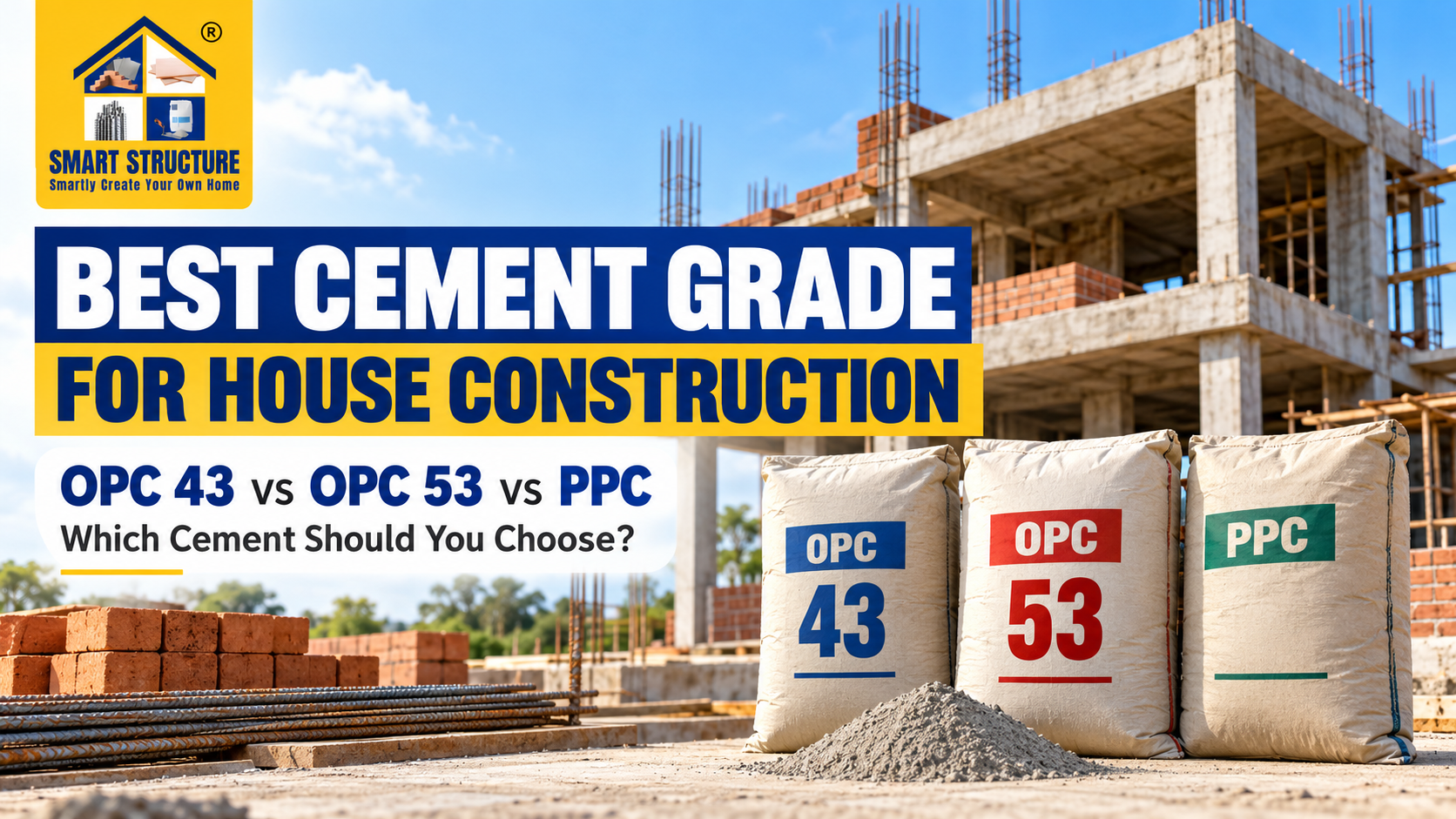
Which cement grade is best for house construction—OPC 43, OPC 53 or PPC cement?
Ghar banane ke liye kaunsa cement best hai? OPC aur PPC cement mein kya difference hai? Kya 53 grade cement hamesha 43 grade se better hota hai?
আর বাড়ি তৈরির জন্য কোন সিমেন্ট ভালো? ছাদ ঢালাই, পিলার, ফাউন্ডেশন আর প্লাস্টারের জন্য OPC না PPC সিমেন্ট ব্যবহার করা উচিত?
For homeowners planning construction in Kolkata, Howrah, New Town, Salt Lake and other parts of West Bengal, choosing the right cement is an important decision.
However, the best cement grade for house construction is not necessarily the highest grade available.
The correct cement depends on your structural design, construction application, exposure conditions, concrete mix, curing requirements and project specifications.
In this comprehensive guide, Smart Structure explains OPC vs PPC cement, OPC 43 vs OPC 53, the best cement for various construction applications and how to make an informed purchase.
1. What Is Cement Grade and Why Does It Matter?
Cement is an essential binding material used in concrete, mortar and several other construction applications.
When cement is mixed with water, a chemical reaction called hydration begins. This process helps the cement mixture develop strength and harden over time.
However, different cement products have different compositions, properties and strength classifications.
For Ordinary Portland Cement (OPC), the commonly recognized grades include:
- OPC 33 Grade
- OPC 43 Grade
- OPC 53 Grade
These grade numbers indicate the minimum compressive strength of standard cement-sand mortar specimens after 28 days of testing, measured in megapascals (MPa).
| Cement Grade | Minimum 28-Day Strength | General Consideration |
|---|---|---|
| OPC 33 | 33 MPa | Selected general construction and mortar applications |
| OPC 43 | 43 MPa | General residential construction where specified |
| OPC 53 | 53 MPa | Applications requiring higher cement strength or early strength development |
According to the Bureau of Indian Standards (BIS), cement must satisfy applicable quality and performance requirements.
Important: OPC 53 does not mean the finished concrete has a strength of M53. Cement grade and concrete grade are different measurements.
For example, M20 concrete refers to concrete with a characteristic compressive strength of 20 MPa after 28 days under standardized testing conditions.
Does Higher Cement Grade Mean Better Construction?
Not always.
Many homeowners believe that choosing OPC 53 automatically makes their house stronger than using OPC 43.
However, concrete performance also depends on:
- Water-cement ratio
- Concrete mix design
- Aggregate quality
- Reinforcement detailing
- Proper mixing and compaction
- Curing
- Construction workmanship
Smart Structure Tip: Cement ka grade important hai, lekin correct cement selection aur proper construction practice usse bhi zyada important hai.
2. What Is OPC Cement?
OPC stands for Ordinary Portland Cement.
It is one of the most widely recognized cement types used in residential, commercial and infrastructure construction.
OPC is produced using Portland cement clinker, gypsum and permitted constituents according to the relevant manufacturing standard.
It is commonly considered for applications requiring reliable strength development and, in some cases, higher early strength.
Advantages of OPC Cement
- Generally develops early strength faster than conventional PPC.
- Available in standardized strength grades.
- Suitable for various structural and non-structural applications when specified.
- Can support construction schedules requiring earlier strength development.
- Commonly used in reinforced cement concrete (RCC).
Limitations of OPC Cement
- Can generate comparatively more heat during hydration.
- May need additional temperature-control considerations in large concrete sections.
- Requires adequate moisture curing.
- Higher strength grades should not be selected without considering the concrete design.
Learn more through this UltraTech Cement guide on OPC vs PPC.
3. What Is PPC Cement?
PPC stands for Portland Pozzolana Cement.
It is a blended cement containing pozzolanic materials such as fly ash or calcined clay, depending on the product and manufacturing standard.
These materials participate in cementitious reactions that can contribute to long-term strength and durability.
PPC generally develops early strength more gradually than many conventional OPC products.
However, it can provide excellent long-term performance when used with proper concrete mix design and curing.
Advantages of PPC Cement
- Often provides good workability.
- Can reduce concrete permeability when properly designed and cured.
- Generally develops lower heat during hydration.
- Can support durable concrete construction.
- Suitable for many RCC, PCC, masonry and plastering applications.
- Reduces reliance on Portland clinker by incorporating supplementary materials.
Limitations of PPC Cement
- Early strength development may be slower.
- Construction scheduling must account for actual strength gain.
- Proper moisture curing remains essential.
- Formwork removal should depend on verified concrete strength and engineering requirements.
Does PPC Cement Have 43 or 53 Grades?
No.
PPC is covered by IS 1489 and is not officially classified into the same OPC 33, 43 and 53 grade system.
Homeowners should not assume that PPC is equivalent to OPC 43 or OPC 53 simply because of marketing descriptions.
4. OPC vs PPC Cement: Complete Comparison
Before selecting the best cement for house construction, understand the major differences.
| Comparison Factor | OPC Cement | PPC Cement |
|---|---|---|
| Full Form | Ordinary Portland Cement | Portland Pozzolana Cement |
| Composition | Portland cement clinker, gypsum and permitted constituents | Portland cement components blended with pozzolanic materials |
| Indian Standard | IS 269 | IS 1489 |
| Strength Grade | OPC 33, 43 and 53 | No equivalent OPC grade classification |
| Early Strength | Generally develops faster | Often develops more gradually |
| Long-Term Strength | Strong performance with proper curing | Can achieve substantial later-age strength |
| Heat of Hydration | Often higher | Generally lower |
| Workability | Depends on product and mix | Often favorable |
| Permeability | Depends on mix and curing | Can be reduced in suitable concrete |
| RCC Construction | Suitable when specified | Suitable when specified |
| Plastering | Suitable products available | Commonly used |
| Sustainability | Typically higher clinker dependence | Can reduce clinker consumption |
| Price | Depends on brand and dealer | Depends on brand and dealer |
OPC vs PPC: Which Is Better?
The answer depends on construction requirements.
OPC may be preferred where earlier strength development is required.
PPC is often considered for workability and potential long-term durability benefits.
Neither cement type automatically guarantees a stronger house.
Hinglish: OPC aur PPC cement mein kaunsa achha hai?
Bengali: OPC আর PPC সিমেন্টের মধ্যে কোনটা ভালো?
Both can be suitable for house construction when the product matches the approved specification.
5. OPC 43 vs OPC 53: Which Cement Grade Is Best for House Construction?
One of the most common questions among homeowners is:
Is OPC 53 better than OPC 43 for house construction?
The difference is primarily associated with standardized cement strength and strength-development characteristics.
OPC 43 Grade Cement
OPC 43 is commonly considered for general building construction where permitted by the project specification.
It may be suitable for residential RCC, masonry-related applications and other work where the approved design allows its use.
OPC 53 Grade Cement
OPC 53 has a higher minimum standardized 28-day cement mortar strength.
It is frequently considered for applications requiring higher cement strength or early strength development.
Examples may include specified RCC work, precast construction and projects with particular construction-schedule requirements.
OPC 43 vs OPC 53 Comparison
| Factor | OPC 43 | OPC 53 |
|---|---|---|
| Minimum 28-Day Mortar Strength | 43 MPa | 53 MPa |
| Early Strength Development | Product dependent | Often higher |
| Residential Construction | May be suitable | May be suitable |
| RCC Applications | Depends on approved mix | Depends on approved mix |
| Proper Curing | Essential | Essential |
| Automatically Stronger House? | No | No |
Which Cement Should You Choose?
For a residential building, the appropriate cement depends on structural specifications and concrete mix requirements.
The number of floors alone does not determine the correct cement grade.
Smart Structure Advice: Don’t choose OPC 53 simply because its number is higher. Consult your engineer and select the correct product for your construction requirements.
6. Which Cement Is Best for Slab, Foundation, Columns and Plastering?
Different construction applications require different performance considerations.
The correct cement selection must follow the approved structural design and material specifications.
| Construction Application | Cement Selection Guidance | Important Consideration |
|---|---|---|
| Foundation | Engineer-approved OPC or PPC | Soil conditions, loads and concrete design |
| RCC Columns | Approved cement meeting mix requirements | Strength, placement and curing |
| RCC Beams | Specified OPC or PPC | Structural performance and construction sequence |
| Roof Slab | Approved OPC or PPC | Proper curing, compaction and formwork removal |
| Brick Masonry | Suitable OPC or PPC | Mortar mix and workmanship |
| Wall Plastering | Suitable OPC or PPC | Workability and curing |
| PCC Flooring | Approved cement | Surface requirements and loading |
| Water-Retaining Structures | Cement specified for the concrete system | Durability, permeability and waterproofing |
Which Cement Is Best for Roof Slab Construction?
Roof slab construction requires careful control of concrete quality, reinforcement, mixing, placement and curing.
Homeowners often search:
- Best cement for roof slab in India
- Chhat dhalai ke liye kaunsa cement best hai?
- ছাদ ঢালাইয়ের জন্য কোন সিমেন্ট ভালো?
Both OPC and PPC can be used for roof slabs when they meet the approved concrete specification.
OPC may provide benefits when earlier strength development is needed.
PPC may offer workability and long-term durability advantages in appropriate mixes.
However, neither product alone can prevent roof leakage.
Waterproofing, roof slope, drainage and construction quality are equally important.
Which Cement Is Best for Foundation Construction?
Foundation requirements depend on ground conditions, structural loads and environmental exposure.
For construction sites with aggressive soil or groundwater conditions, the structural engineer may specify particular cement or concrete durability requirements.
Which Cement Is Best for Plastering?
PPC is commonly considered for plastering because of its workability.
Suitable OPC products may also be used.
The quality of plaster depends on mortar proportions, substrate preparation, application technique and proper curing.
7. Which Cement Is Better for Kolkata and West Bengal Homes?
Kolkata experiences humid weather, substantial monsoon rainfall and periods of high temperature.
These conditions make material storage, moisture control and construction practices particularly important.
For people building houses in Kolkata, Howrah, Behala, Salt Lake, New Town and nearby areas, cement selection should consider several important factors.
A. Monsoon and Moisture Exposure
Moisture exposure can affect building materials and long-term concrete durability.
Properly designed PPC concrete may provide permeability-related advantages in some applications.
However, effective waterproofing and construction detailing are still required.
B. Construction Schedule
If the construction process requires higher early strength, an engineer may recommend a suitable OPC product or another approved cement-concrete combination.
C. Cement Storage
Cement bags must be protected from rainfall, damp floors and excessive humidity.
Improper storage can damage cement before it is used.
D. Local Product Availability
Before ordering cement, confirm the correct product specifications, available stock and delivery arrangements.
Bengali Tip: Kolkata te bari bananor jonno cement choose korar shomoy sudhu brand noy—cement type, quality, storage aar engineer-er recommendation check korun.
For additional guidance, read:
Best Cement for House Construction in Kolkata: OPC vs PPC vs PSC Explained
8. OPC vs PPC: Which Cement Is More Cost-Effective?
When planning a house construction budget, cement price becomes an important consideration.
However, the lowest-priced bag is not always the most economical choice.
Cement prices depend on:
- Cement manufacturer and brand
- Cement type and grade
- Dealer quotation
- Local product availability
- Transportation distance
- Order quantity
- Loading and unloading costs
- Applicable taxes
Cement Buying Cost Comparison
| Buying Factor | What to Check |
|---|---|
| Cement Type | OPC, PPC or another approved type |
| Cement Grade | Applicable grade for OPC |
| Bag Weight | Actual printed net weight |
| Manufacturing Details | Batch and packing information |
| Dealer Price | Current quotation |
| Transportation | Delivery charges |
| Taxes | Whether GST is included |
| Total Cost | Final delivered price |
Comparing cement prices correctly means comparing the same approved product under similar delivery conditions.
For local pricing information, explore:
Cement Price in Kolkata – Smart Structure Buying Guide
9. How Much Cement Is Required for House Construction?
After choosing the cement type, homeowners must calculate the required quantity.
Common questions include:
- Ghar banane mein kitni cement ki bori lagegi?
- 1000 sq ft house construction mein kitna cement lagega?
- ১০০০ স্কয়ার ফুট বাড়ি বানাতে কত বস্তা সিমেন্ট লাগবে?
The amount of cement required depends on:
- Total constructed area
- Number of floors
- Structural design
- Foundation requirements
- Concrete mix proportions
- Brick masonry quantities
- Plastering area
- Flooring and finishing requirements
Basic Cement Bag Formula
Number of Cement Bags = Total Cement Quantity (kg) ÷ Weight per Bag (kg)
For example:
If your approved material estimate specifies 5,000 kg of cement and each bag contains 50 kg:
5,000 ÷ 50 = 100 cement bags
This is a quantity-conversion example, not a structural mix-design recommendation.
For detailed calculations involving cement, TMT steel, bricks, sand, aggregate and tiles, read:
How to Calculate Building Material Quantity for House Construction
Always verify quantities with the approved drawings, bill of quantities and construction specifications.
10. Seven Common Mistakes When Choosing Cement
Mistake 1: Choosing the Highest Grade Automatically
OPC 53 is not automatically the best option for every construction application.
Mistake 2: Buying Cement Only by Brand
Different products from the same manufacturer may have different compositions and intended applications.
Mistake 3: Ignoring Packing Details
Always inspect the manufacturing or packing information and confirm that bags have been stored properly.
Mistake 4: Choosing Only by Cement Price
Compare product suitability, quality, dealer reliability and delivered price.
Mistake 5: Adding Excess Water
Adding unnecessary water to a concrete mix can reduce strength and durability.
Mistake 6: Improper Curing
Both OPC and PPC require appropriate curing. Follow the project specification and applicable concrete standards.
Mistake 7: Changing Cement Without Approval
Never substitute cement during structural work without reviewing the change with the responsible engineer.
11. How to Check Cement Quality Before Buying
Choosing a genuine, properly stored product is essential.
| Quality Check | What to Verify |
|---|---|
| BIS Marking | Applicable certification and Indian Standard |
| Cement Type | Correct OPC, PPC or other specified product |
| Cement Grade | Applicable OPC grade |
| Packing Information | Manufacturer and batch details |
| Bag Condition | No water damage or hardened lumps |
| Storage | Protected from moisture |
| Dealer Details | Reliable source and invoice |
| Specification | Matches approved construction requirements |
For more information, visit the Bureau of Indian Standards.
12. How Smart Structure Makes Cement Buying Easier
Traditionally, homeowners often visit several building-material shops before finding the right product.
One dealer may have OPC cement available, while another may offer PPC cement.
Checking stock, comparing options and coordinating purchases can become time-consuming.
Smart Structure helps simplify building-material discovery and comparison.
Through the Smart Structure customer marketplace, users can explore construction materials and compare available offerings from participating local dealers.
Why Explore Cement Through Smart Structure?
Explore Building Materials
Browse cement alongside TMT steel, bricks, sand, aggregates, tiles, sanitary products, electrical supplies and other construction materials.
Compare Product Options
Explore available brands and products based on your construction requirements.
Find Local Dealers
Discover offerings from participating verified building-material dealers.
Plan Material Purchases
Organize your construction-material buying process using a digital marketplace.
Instead of visiting multiple shops to ask:
“OPC 53 available hai?”
“PPC cement ka rate kya hai?”
“Site tak delivery possible hai?”
Start by exploring your available options through Smart Structure.
Start Your Smart Construction Journey
Whether you are constructing your first home, renovating an existing property or managing a residential project, selecting the correct cement is an important step.
Explore building materials on Smart Structure:
https://smartstructure.co.in/
Product availability, final prices and delivery arrangements depend on the participating dealer and location.
Ghar banane ke liye right cement choose karo, available options compare karo aur Smart Structure ke saath smartly apna home create karo.
বাড়ি তৈরির জন্য সঠিক সিমেন্ট বেছে নিন, বিভিন্ন অপশন তুলনা করুন আর Smart Structure-এর সঙ্গে স্মার্টভাবে নিজের বাড়ি তৈরি করুন।
13. Frequently Asked Questions (FAQs)
Q1. Which cement grade is best for house construction in India?
OPC 43, OPC 53 and suitable PPC products can all be used in residential construction when they match the approved application and concrete specification. The final choice should be made with the structural engineer.
Q2. Is OPC 53 better than OPC 43?
OPC 53 has a higher minimum standardized 28-day mortar strength, but it is not automatically better for every construction application.
Q3. Which cement is best for roof slab construction?
Both OPC and PPC may be suitable for roof slab construction. The correct choice depends on concrete mix design, strength requirements and approved specifications.
Q4. Is PPC cement strong enough for house construction?
Yes. PPC can be used for many residential construction applications, including approved RCC work, when the concrete mix meets the required performance standards.
Q5. Which cement is best for plastering?
PPC is commonly used for plastering because of its workability. Suitable OPC products may also be used where specified.
Q6. Can PPC cement be used for columns and beams?
Yes, PPC can be used in suitable reinforced concrete applications when the approved mix design and strength-development requirements permit it.
Q7. Is PPC cement waterproof?
No. PPC may help produce concrete with reduced permeability when properly designed and cured, but waterproofing requires appropriate materials, detailing and workmanship.
Q8. Does PPC have 43 or 53 grades?
No. PPC is governed by IS 1489 and does not use the official OPC 33, 43 and 53 grade classification.
Q9. Which cement is best for a two-storey house?
The number of storeys alone does not determine cement selection. Structural loading, approved concrete grade, exposure conditions and mix design must be considered.
Q10. Where can I compare cement options in Kolkata?
Visit Smart Structure to explore building materials and compare available product options from participating local dealers.
Final Verdict: OPC vs PPC – Which Cement Should You Choose?
Choosing the best cement grade for house construction is not about selecting the highest number printed on a cement bag.
It is about selecting the right material for the right application.
OPC Cement: Often considered when earlier strength development is important.
PPC Cement: Frequently considered for its workability and potential long-term durability benefits.
OPC 43 vs OPC 53: Both can be suitable depending on the approved construction specification.
The correct cement should meet your engineer’s requirements, applicable Indian Standards and the intended concrete performance.
Before purchasing cement, always check the product type, grade where applicable, manufacturing details, storage condition and final delivered cost.
Your dream home deserves the right construction materials—not simply the cheapest product or highest cement grade.
Build Better. Build Smarter.
Smart Structure — Smartly Create Your Own Home.
Explore Building Materials: https://smartstructure.co.in/