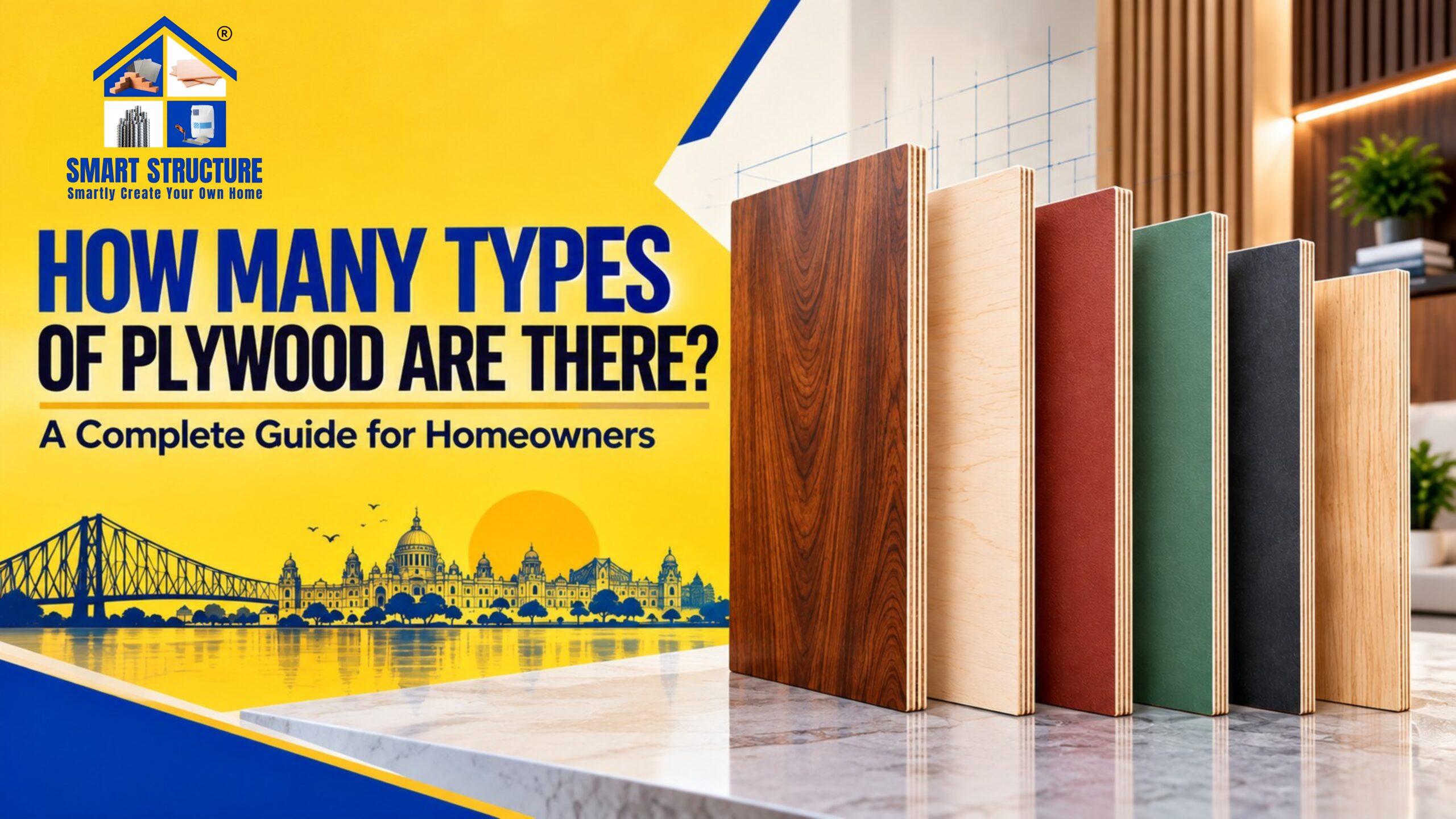
Planning a wardrobe, modular kitchen or renovation? Terms like MR, BWR, BWP, marine and calibrated plywood can be confusing. Choosing the wrong sheet risks swelling, peeling and avoidable costs.
So, how many types of plywood are there? In India, general-purpose plywood has three main moisture-resistance grades: MR, BWR and BWP. Beyond these, several specialized plywood varieties are sold for particular finishes and applications. Here are eight common categories every homeowner should understand before buying.
What Makes One Plywood Type Different from Another?
Plywood bonds thin wood veneers with alternating grain directions, improving stability and strength.
Plywood can be classified by water resistance, construction, surface finish or intended use. These classifications overlap: decorative plywood, for example, might also be BWR grade. So there is no fixed number of plywood types.
8 Common Types of Plywood and Their Uses
1. MR Plywood (Moisture Resistant)
Often called commercial plywood, MR plywood suits dry indoor spaces such as bedroom wardrobes, study tables and wall panels. It can tolerate normal indoor humidity but is not waterproof. Avoid using it where leaks or frequent splashes are likely.
2. BWR Plywood (Boiling Water Resistant)
BWR plywood offers stronger resistance to moisture than MR plywood. It is a practical option for many kitchen cabinets, furniture units and homes affected by seasonal humidity. However, “water resistant” does not mean you can leave a cabinet exposed to standing water.
3. BWP Plywood (Boiling Water Proof)
BWP plywood is designed for more demanding wet conditions. Homeowners often consider it for under-sink cabinets, bathroom-adjacent storage and other moisture-prone furniture. Under IS 303:2024, BWP is one of the three general-purpose grades. Check the actual standard printed on the sheet rather than assuming every BWP board is marine plywood.
4. Marine Plywood
Marine plywood is manufactured for demanding moisture exposure and is covered by IS 710:2024, a separate Indian Standard. It may be appropriate for specialized wet-area or exterior applications when recommended by the manufacturer. It generally costs more, so avoid paying a premium where ordinary interior-grade plywood is sufficient.
5. Decorative Plywood
Decorative plywood features a visually appealing surface, often with a natural wood veneer. It works well for premium furniture, doors, wall paneling and feature surfaces. Appearance is its selling point; always verify the underlying moisture-resistance grade separately.
6. Calibrated Plywood
Calibrated plywood is processed to achieve a more consistent thickness and smoother surface. This can make it useful for modular furniture, precision cabinetry and laminate finishing. Calibration describes the sheet’s dimensional finish, not its ability to withstand water.
7. Flexible Plywood
Need a curved desk, rounded wall or unusual furniture shape? Flexible plywood bends more readily than standard sheets. It is mainly chosen for decorative curves, not automatically for heavy structural loads.
8. Fire-Retardant Plywood
Fire-retardant plywood is treated or manufactured to slow flame spread under specified test conditions. It suits projects with specific fire-safety requirements. It is not fireproof; check compliance with IS 5509:2021 and follow your architect’s specification.
Plywood Types Comparison Table
| Type | Main Advantage | Common Use | Moisture Suitability |
|---|---|---|---|
| MR | Economical | Wardrobes, study tables | Dry interiors |
| BWR | Better moisture resistance | General cabinets | Humid interiors |
| BWP | Higher water resistance | Under-sink storage | Wet-prone areas |
| Marine | Demanding-duty specification | Special wet applications | High exposure |
| Decorative | Attractive finish | Feature panels | Depends on base grade |
| Calibrated | Uniform thickness | Modular cabinetry | Depends on base grade |
| Flexible | Curved shapes | Decorative furniture | Depends on base grade |
| Fire-retardant | Slower flame spread | Specified safety applications | Depends on base grade |
Note: These are practical buying categories, not eight mutually exclusive BIS grades.
Which Plywood Should You Choose for Your Kolkata Home?
Kolkata’s humid weather makes moisture exposure an important consideration, especially during the monsoon. Match the plywood to the room rather than automatically buying the most expensive option.
- Bedroom: MR or BWR may work for dry wardrobes, depending on site conditions.
- Kitchen: Consider BWR for suitable cabinet areas and BWP for places facing repeated splashes.
- Bathroom vanity: Look for a suitable higher-resistance product, sealed edges and reliable plumbing.
- Curved interiors: Ask about flexible plywood and its recommended finishing system.
Before placing an order, compare sheet dimensions, thickness, core quality, certification, warranty and delivered price. Also check the ISI mark and manufacturer’s licence details where certification is claimed. A well-chosen sheet still needs correct installation and protection from leaks.
How to Choose the Right Plywood Thickness for Your Furniture?
Apart from understanding the different types of plywood, choosing the correct thickness is equally important. Plywood thickness affects furniture strength, stability, weight and overall cost.
Different furniture applications require different thicknesses depending on the load, design and installation method.
| Plywood Thickness | Common Applications | Key Consideration |
|---|---|---|
| 6 mm | Decorative panels, furniture backing | Lightweight applications |
| 9 mm | Cabinet backs, drawer bottoms | Suitable support required |
| 12 mm | Light partitions, cabinet components | Check panel span and load |
| 16 mm | Furniture panels, selected cabinetry | Balanced thickness for suitable designs |
| 18–19 mm | Wardrobes, shelves, furniture panels | Commonly used for furniture |
| 25 mm | Heavy-duty furniture components | Used where additional thickness is specified |
Expert Tip: Thicker plywood does not automatically mean better furniture. The right choice depends on plywood grade, core quality, supported load and furniture construction.
How to Protect Plywood Furniture During Kolkata’s Monsoon?
Kolkata’s humid climate and heavy monsoon rainfall can affect wooden furniture, especially when plywood is exposed to excessive moisture.
Even high-quality moisture-resistant plywood requires proper installation and maintenance to achieve its expected service life.
Here are some practical ways to protect plywood furniture:
- Seal exposed edges: Apply suitable edge banding or sealants to reduce moisture penetration.
- Prevent water leakage: Repair leaking pipes and fittings, especially around kitchen sinks and bathroom cabinets.
- Maintain ventilation: Allow sufficient airflow around cupboards and furniture installed near damp walls.
- Choose suitable finishes: Use appropriate laminates, coatings or veneers based on the furniture’s location.
- Avoid prolonged water contact: Clean spills promptly, even when using BWR or BWP plywood.
Proper maintenance can help improve furniture durability and reduce the likelihood of swelling, surface damage or deterioration.
5 Common Mistakes to Avoid When Buying Plywood
Choosing plywood based only on its appearance or price can lead to unnecessary expenses. Here are five common mistakes homeowners should avoid.
1. Selecting the wrong plywood grade
Using MR plywood in areas exposed to frequent splashes can increase the risk of moisture damage. Always match the grade to the environment.
2. Ignoring plywood thickness
Choosing a sheet that is too thin for the intended load may affect furniture stability and performance.
3. Not checking product quality
Inspect the plywood surface, edges, veneer bonding and available certification details before purchasing.
4. Comparing prices without checking specifications
Two plywood sheets may look similar but differ significantly in grade, thickness, core composition and warranty.
5. Overlooking installation and finishing
Even good-quality plywood can deteriorate prematurely if edges are left unsealed or the furniture is repeatedly exposed to leaks.
How to Choose Plywood That Offers the Best Value for Money?
The best plywood is not necessarily the most expensive product. It is the one that meets your furniture’s requirements while offering suitable quality, performance and value.
Before finalizing your purchase, consider these four factors:
- Purpose: Identify whether the plywood will be used for wardrobes, modular kitchens, partitions or decorative furniture.
- Environment: Evaluate humidity, ventilation and possible water exposure.
- Specifications: Compare plywood grade, thickness, core quality and manufacturer recommendations.
- Overall cost: Consider sheet prices, required quantities, cutting wastage, finishing materials and delivery charges.
For homeowners purchasing plywood in Kolkata, comparing equivalent product specifications can help identify suitable materials without compromising on essential quality requirements.
Final Thoughts: Choosing the Best Plywood for Your Home
Understanding plywood types, grades, thicknesses and their applications can make your furniture and renovation decisions easier.
Whether you need commercial plywood for a bedroom wardrobe, BWR plywood for suitable cabinetry or a specialized grade for moisture-prone areas, choosing according to the intended use can help prevent avoidable expenses.
The key is to focus on suitability, material quality and long-term performance rather than price alone. With the right specifications and proper installation, plywood can provide a strong and versatile foundation for your home interiors.
Frequently Asked Questions
Which plywood is best for home furniture?
For dry-room furniture, MR or BWR can be suitable. Select the grade according to humidity, loading, budget and the manufacturer’s recommendations.
Are BWP and marine plywood the same?
Not necessarily. BWP is also a general-purpose grade under IS 303:2024, while certified marine plywood is covered by IS 710:2024.
How do I compare plywood prices in Kolkata?
Compare products with the same grade, thickness, sheet size and core specification, then consider delivery charges. A lower sheet price does not always mean better value.
With Smart Structure, homeowners and construction professionals in Kolkata can explore building materials, compare available product options and make more informed purchasing decisions.
Explore plywood and other building materials on Smart Structure and start planning your next home improvement project with confidence.
Now that you know the main types of plywood, choosing for your home becomes easier. Explore the plywood category on Smart Structure to review available product options and compare specifications. Use the plywood requirement calculator to plan quantities, or read our Kolkata plywood buying guide before ordering.