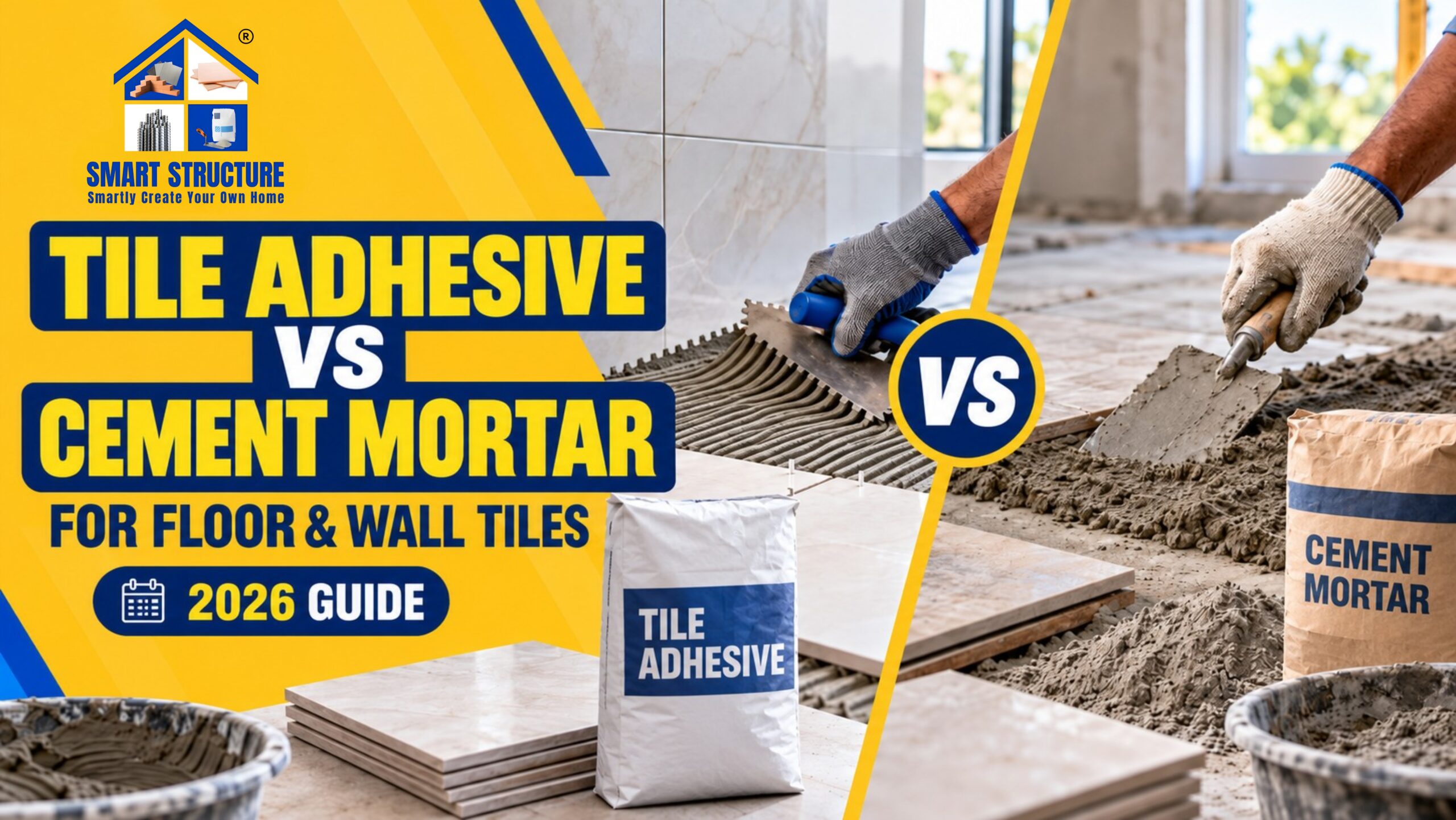
Planning floor or wall tiling for your home? Compare tile adhesive and cement mortar based on bonding strength, installation cost, durability, tile compatibility and suitability for Kolkata’s climate.
Beautiful tiles can transform a home. But even premium tiles may develop cracks, become loose or produce a hollow sound if the installation materials and methods are unsuitable.
That’s why homeowners should ask an important question before beginning tiling work:
Tile Adhesive vs Cement Mortar — which is better for floor and wall tiles?
Traditionally, Indian masons have used cement and sand mortar for laying tiles. Today, modern tile adhesives offer specialised solutions for ceramic, vitrified, porcelain and large-format tiles.
But is tile adhesive always better? Is traditional cement mortar cheaper? Which option should you choose for bathrooms, kitchens and living rooms?
Floor tiles lagane ke liye tile adhesive better hai ya cement mortar? Dono mein kaunsa zyada strong aur long-lasting hai?
Floor tiles laganor jonno tile adhesive bhalo naki cement mortar? Kon material beshi durable aar budget-friendly?
In this 2026 guide, Smart Structure explains the differences so homeowners in Kolkata and West Bengal can make informed construction decisions.
1. What Is Tile Adhesive?
Tile adhesive is a specially formulated bonding material used to fix tiles to suitable prepared surfaces.
Many commonly used tile adhesives are factory-manufactured cementitious products containing cement, graded fillers and performance-enhancing additives. Other adhesive systems are available for specialised applications.
The exact formulation depends on the intended use.
Advantages of Tile Adhesive
- Consistent factory-controlled formulation
- Suitable options for ceramic, vitrified and porcelain tiles
- Thin-bed application for properly prepared surfaces
- Good bond performance when the correct product is selected
- Specialised options for wet areas and exterior applications
- Products available with improved slip resistance for wall tiling
- Suitable solutions for selected tile-on-tile renovation projects
Tile adhesive is particularly useful where precise installation and compatibility with modern low-absorption tiles are important.
However, not every adhesive is suitable for every tile.
Always check the manufacturer’s technical data sheet before purchasing.
2. What Is Cement Mortar?
Cement mortar is a mixture of cement, sand and water used for various masonry, plastering and flooring applications.
Traditional tile installation may involve placing tiles over a relatively thick layer of cement-sand mortar.
This method has been used in Indian residential construction for decades.
Advantages of Cement Mortar
- Familiar to many traditional masons
- Cement and sand are widely available
- Can form part of suitable thick-bed installation systems
- Useful for creating or adjusting a bedding layer
- May offer a lower initial material cost in certain applications
Limitations of Cement Mortar
Traditional cement mortar can present difficulties when bonding directly to dense, low-absorption tiles.
Results depend heavily on the mortar mix, installation method, substrate condition and workmanship.
Cement mortar should not automatically be treated as interchangeable with a tested tile adhesive.
Important: A cement-sand screed or mortar bed can still be used to prepare or level a floor before installing tiles with adhesive. The two materials are not always competing alternatives.
3. Tile Adhesive vs Cement Mortar: Complete Comparison
| Comparison Factor | Tile Adhesive | Cement Mortar |
|---|---|---|
| Composition | Specially formulated bonding product | Cement, sand and water |
| Application | Usually thin-bed, product dependent | Often traditional thick-bed |
| Bond performance | Tested for specified tile applications | Depends on mix and installation |
| Vitrified tiles | Suitable products available | Conventional direct fixing may be unsuitable |
| Large-format tiles | Specialised products available | Requires an appropriately designed system |
| Wall application | Non-slip products available | Depends on traditional fixing method |
| Surface preparation | Clean, sound, appropriately level substrate | Preparation also essential |
| Initial material cost | Often higher per kg | Often lower material cost |
| Installation efficiency | Can be faster on prepared surfaces | May involve more site mixing and levelling |
| Wet areas | Wet-area-rated products available | Not waterproof by itself |
| Product consistency | Factory-controlled | Depends on site batching |
| Best use | Modern specified tile-fixing systems | Bedding, levelling and approved traditional methods |
Smart Structure Tip: The better choice is the installation system that suits your tile type, floor or wall surface, moisture exposure and project specifications.
4. Which Is Better for Floor Tiles?
The ideal fixing material for floor tiles depends on their size, material, thickness and the prepared floor surface.
Ceramic Floor Tiles
Some traditional ceramic tiles can be installed using approved cement mortar systems.
However, a suitable tile adhesive can provide predictable bonding characteristics when used according to the manufacturer’s instructions.
Vitrified Floor Tiles
Vitrified tiles are dense and have low water absorption.
Because of this, traditional cement-sand fixing methods may not provide the required bond for some products and applications.
A compatible polymer-modified tile adhesive is often the more appropriate option.
Large-Format Floor Tiles
Large tiles need careful installation because uneven adhesive coverage, poor substrate flatness and incorrect joint detailing can create problems.
Choose an adhesive specifically approved for the tile’s size and application.
Large-format installations may also require back-buttering, appropriate trowels and additional surface preparation.
Verdict: For many modern vitrified and large-format residential floors, the right tile adhesive is generally the preferred fixing material.
To select suitable flooring products, read Smart Structure’s Tile Buying Guide for Kolkata Homes.
5. Which Is Better for Wall Tiles?
Wall tile installation requires particular attention to bonding and tile movement during installation.
Unlike floor tiles, wall tiles must remain in position on a vertical surface while the bonding material develops strength.
A suitably classified, slip-resistant tile adhesive can help reduce downward movement during installation.
For ceramic wall tiles, kitchens and bathroom walls, choose a product approved for the tile and substrate.
For large or heavy wall tiles, the specification becomes more important. Tile weight, wall height, substrate strength and any required mechanical support must be considered.
Bathroom wall par tiles lagane ke liye sirf strong adhesive nahi, correct wall preparation aur suitable product selection bhi zaroori hai.
Verdict: A suitable wall-rated tile adhesive is generally a practical choice for modern wall tiling, particularly for vitrified or larger-format tiles.
6. Tile Adhesive vs Cement Mortar for Bathrooms
Bathrooms experience regular exposure to water, cleaning chemicals and humidity.
That makes the complete installation system especially important.
For bathroom floors and walls, select materials suitable for the expected moisture exposure.
What Should You Check?
- Correct waterproofing system beneath the tile finish where required.
- Compatible adhesive approved for wet areas.
- Proper drainage slopes and floor preparation.
- Suitable tile grout and movement-joint sealants.
- Correct installation and curing procedures.
Remember: Tile adhesive and grout are not substitutes for waterproofing.
Even a high-quality tile adhesive cannot prevent bathroom leakage if the waterproofing layer, pipe penetrations or drainage details are defective.
For related construction chemicals and waterproofing materials, explore Smart Structure’s Construction Chemicals Guide.
7. Tile Adhesive vs Cement Mortar Cost in Kolkata
Many homeowners ask:
Is tile adhesive more expensive than cement mortar?
Tile adhesive generally costs more per kilogram than a basic cement-sand mixture.
However, the material price alone does not determine the total tiling cost.
Complete Tile Installation Cost
Total Cost = Surface Preparation + Bedding/Levelling + Adhesive or Mortar + Labour + Grout + Finishing + Other Required Materials
Waterproofing, tiles, transport and site handling should also be included where applicable.
Example: Tile Adhesive for 100 Sq. Ft.
One manufacturer’s technical data sheet for a specific floor-and-wall adhesive gives an approximate coverage of 55–60 sq. ft. per 20 kg bag at a nominal 3 mm bed thickness.
Using that product’s stated coverage:
100 ÷ 60 = 1.67 bags
100 ÷ 55 = 1.82 bags
Therefore, the preliminary quantity would be approximately two 20 kg bags, before allowing for actual site conditions or additional requirements.
This is an example for that particular product, not a universal adhesive coverage rate.
Different adhesive formulations, tile sizes, trowel dimensions and substrates can change consumption significantly.
How to Compare Quotations
Ask your contractor or dealer for two complete quotations covering the same tile area and installation requirements.
Compare:
- Product specification and quantity
- Surface preparation and screed work
- Mortar or adhesive material cost
- Labour charges
- Wastage allowance
- Grouting and finishing
- Delivery charges
- Potential repair or maintenance implications
Sirf cement mortar ka rate kam hone se poora tiling project cheap nahi ho jaata. Total installation cost compare karein.
Avoid using a generic price per square foot without checking what is included.
8. Which Material Is Better for Kolkata’s Humid Climate?
Kolkata experiences hot, humid weather and substantial rainfall during the monsoon.
These conditions make proper storage, surface preparation and moisture protection especially important.
Tile installation failures may occur when work is carried out over damp, contaminated, weak or unsuitable surfaces.
Important Precautions for Kolkata Homes
- Protect adhesive bags and cement from rain and humidity.
- Check whether the substrate is suitable for installation.
- Complete specified waterproofing work before tiling.
- Use products intended for the installation location.
- Follow the manufacturer’s mixing and open-time instructions.
- Allow the required setting time before grouting or allowing traffic.
- Maintain correct drainage on balconies, terraces and bathrooms.
A suitable tile adhesive can perform well in wet environments when used as part of a correctly specified system.
However, no adhesive can compensate for poor waterproofing or a defective substrate.
Kolkatay brishtir shomoy tile laganor age surface preparation, waterproofing aar adhesive-er quality bhalo kore check korun.
9. How to Choose the Right Tile Adhesive in India
India’s IS 15477:2019 standard covers adhesives for ceramic, mosaic and stone tiles.
It identifies multiple adhesive types and performance-related classifications.
Homeowners may also encounter international classifications such as C1, C2, T, E, S1 and S2 on product documentation.
These codes describe performance characteristics under the relevant testing system. Indian Standard types and international codes should not be treated as directly interchangeable.
Before Buying, Check:
Tile Material: Ceramic, vitrified, porcelain or natural stone.
Tile Size: Small, medium or large format.
Installation Area: Interior floor, wall, bathroom, balcony or exterior.
Substrate: Concrete, cement screed, cement plaster or another approved surface.
Product Compatibility: Confirm that the selected adhesive is suitable for the intended application.
Packaging: Verify batch details, shelf life, storage instructions and manufacturer identification.
For quality verification tips, read How to Identify Original vs Low-Quality Construction Materials.
10. Seven Common Tile Installation Mistakes to Avoid
Mistake 1: Choosing Adhesive Only by Price
The cheapest adhesive may not meet your tile’s requirements.
Mistake 2: Installing Tiles Over Dust or Loose Material
The substrate must be sound and properly prepared.
Mistake 3: Adding Extra Water During Mixing
Incorrect water proportions can change adhesive performance.
Mistake 4: Ignoring Tile Size and Weight
Large-format and heavy tiles may need specialised materials and installation techniques.
Mistake 5: Applying Adhesive After Its Open Time
Adhesive left exposed for too long may lose its ability to provide a reliable bond.
Mistake 6: Ignoring Movement Joints
Tile work requires appropriate joints to accommodate building and thermal movement.
Mistake 7: Treating Adhesive as a Waterproofing Product
Use a properly designed waterproofing system wherever required.
Professional installation and correct product selection are equally important.
11. Where to Buy Tile Adhesive and Tiling Materials in Kolkata
Choosing suitable tile-fixing products becomes easier when you know the exact material requirements.
Before placing an order, prepare the following information:
- Tile type and dimensions
- Total floor or wall area
- Interior or exterior application
- Surface condition
- Required adhesive specification
- Estimated number of bags
- Delivery location and schedule
Through Smart Structure, homeowners can explore building materials and compare available options from participating dealers.
Whether you are searching for tiles, cement or construction chemicals for a new home or renovation, organise your material requirements before purchasing.
Explore the Smart Structure website or download the Smart Structure Customer App.
SEARCH → COMPARE → SELECT → ORDER
Tiles, cement aur construction chemicals chahiye? Smart Structure App par material options explore karein.
Bari renovation-er jonno tiles aar construction materials khujchen? Smart Structure App-e available options compare korun.
12. Final Verdict: Tile Adhesive or Cement Mortar?
So, Tile Adhesive vs Cement Mortar — which is better for your home?
For modern vitrified tiles, porcelain tiles, many wall applications and large-format installations, a suitably specified tile adhesive is generally the stronger choice.
Traditional cement mortar still has a useful role in appropriate thick-bed flooring systems and surface preparation.
But neither material guarantees a durable tile installation on its own.
The final performance depends on the tile, substrate, moisture protection, product compatibility, workmanship and curing.
Choose the right installation system, not simply the lowest-priced material.
Build Better. Build Smarter.
Smart Structure — Smartly Create Your Own Home.
Frequently Asked Questions (FAQs)
1. Is tile adhesive better than cement for floor tiles?
For many modern vitrified, porcelain and large-format tile installations, a suitable tile adhesive offers better-controlled bonding performance. Cement mortar can still be used in appropriate traditional bedding systems.
2. Can I use cement mortar for vitrified tiles?
Conventional direct cement-sand fixing may not be appropriate for low-absorption vitrified tiles. Follow the tile manufacturer’s approved installation method and use a compatible adhesive where required.
3. Which is cheaper: tile adhesive or cement mortar?
Cement-sand mortar often costs less as a raw material, but the total installed cost depends on surface preparation, labour, quantity, wastage and finishing.
4. Which adhesive is best for bathroom wall tiles?
Choose a wall-rated adhesive approved for the selected tile, substrate and wet-area conditions. Proper waterproofing must be provided separately where specified.
5. Can tile adhesive be used over existing tiles?
Some adhesives are approved for tile-on-tile applications. The existing surface must be sound, securely bonded and prepared according to the selected product’s instructions.
6. How much tile adhesive is required for 100 sq. ft.?
The quantity depends on product coverage, tile size, trowel selection, bed thickness and substrate condition. Check the manufacturer’s coverage table rather than relying on a fixed bag count.
7. Does tile adhesive prevent hollow tiles?
Correct adhesive selection and adequate coverage can reduce some installation problems, but hollow-sounding tiles may also result from substrate defects, inadequate bedding, movement or poor workmanship.
Technical References
- Bureau of Indian Standards — IS 15477:2019 Product Manual
- MYK LATICRETE — Floor & Wall Tile Adhesive Technical Data Sheet
- ARDEX ENDURA — Cement vs Tile Adhesive Guide
Disclaimer: This guide provides general material-selection information. Actual installation requirements depend on the tile manufacturer’s recommendations, substrate, exposure conditions and applicable standards. Consult a qualified tiling professional for project-specific advice. Product prices and availability may change.