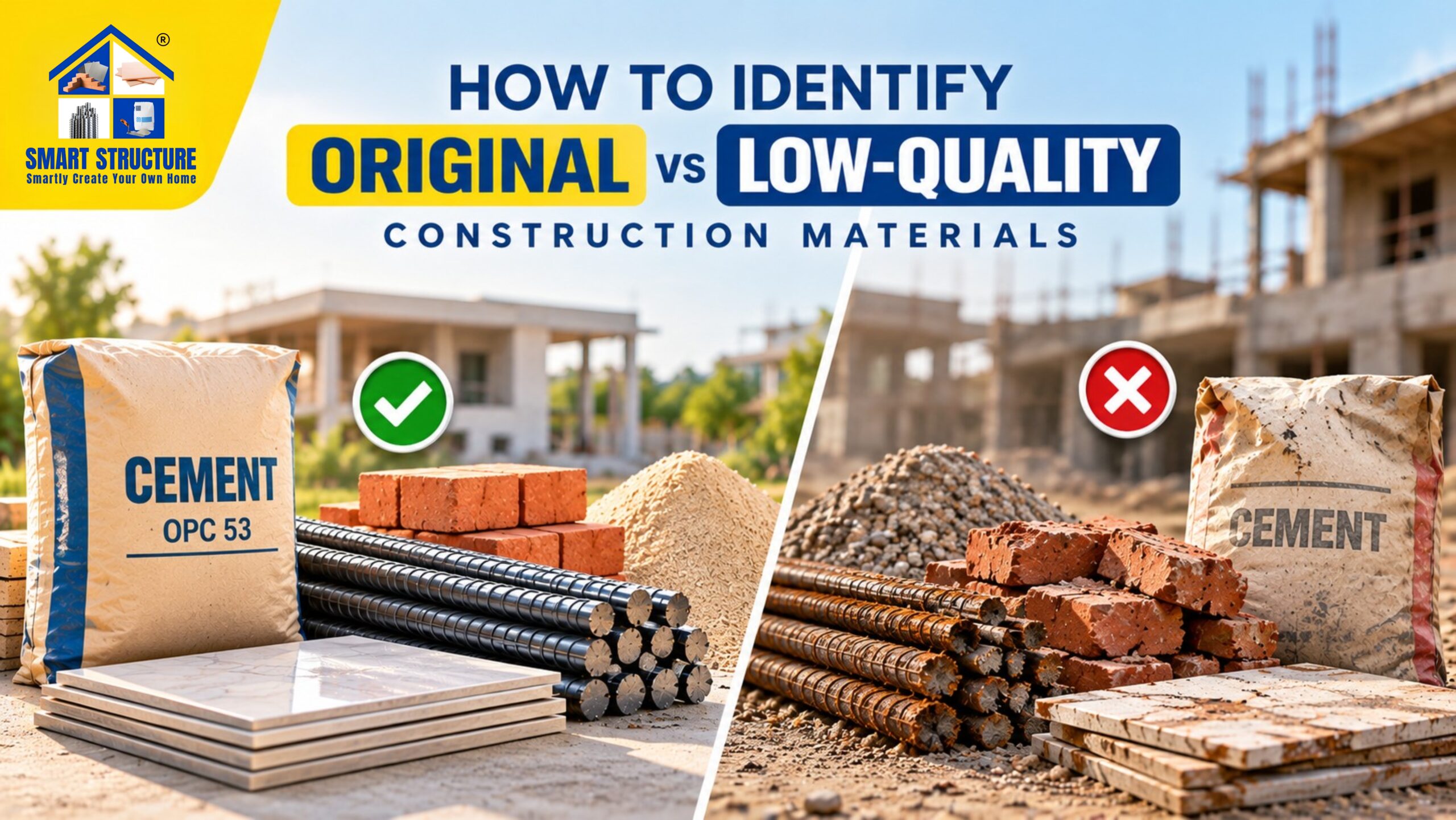
Building a house is one of the biggest investments of your life. But how can you be sure that the cement, TMT steel, bricks, sand, tiles and other building materials you purchase are genuine and meet the required quality standards?
Choosing original construction materials is essential for building a strong, safe and durable home.
In today’s construction market, low-quality, counterfeit, damaged and incorrectly labelled products can sometimes look almost identical to genuine branded materials.
Whether you are constructing a new home in Kolkata, renovating your apartment in Howrah or purchasing construction supplies anywhere in West Bengal, understanding how to identify original building materials can help you avoid costly mistakes.
Ghar banane ke liye original building material kaise pehchanein? Cement asli hai ya duplicate kaise check karein? TMT steel ki quality kaise verify karein?
Bari bananor jonno original construction material chinben ki kore? Cement, rod, balu aar bricks-er quality ki bhabe check korben?
In this Smart Structure guide, we explain 10 important checks to help you identify genuine construction materials, recognize warning signs and make better purchasing decisions.
Why Choosing Original Construction Materials Matters
Construction quality depends heavily on the materials used during the building process.
Every material, from foundation concrete to electrical wiring, plays a role in the safety, functionality and long-term performance of a property.
Poor-quality or unsuitable building materials may contribute to:
- Cracks in walls and concrete surfaces
- Reduced concrete strength
- Premature corrosion of reinforcement steel
- Water leakage and dampness
- Broken or uneven flooring
- Peeling paint and damaged finishes
- Electrical overheating and potential fire hazards
- Plumbing leakage
- Increased maintenance and repair costs
- Delays in construction
A cheaper material may appear economical during purchasing, but replacement, repair and additional labour expenses can make it more expensive over time.
However, a genuine branded product is not automatically suitable for every project. It must also match the required specification and be stored, transported and installed correctly.
Smart Structure Tip: Sirf material ka price compare mat kijiye. Uski quality, grade, certification aur dealer reliability bhi check kijiye.
Original vs Low-Quality Construction Materials: What’s the Difference?
Understanding the difference between original and low-quality building materials is the first step toward making an informed decision.
Original materials come from an identifiable manufacturer and can be checked against the stated product specifications.
Low-quality materials may be incorrectly manufactured, contaminated, damaged through poor storage or falsely represented.
| Quality Factor | Genuine, Specification-Compliant Material | Potentially Low-Quality Material |
|---|---|---|
| Manufacturer | Identifiable and traceable | Unknown or misleading details |
| Packaging | Properly labelled and intact | Damaged, altered or incomplete |
| Product Grade | Matches stated specifications | Incorrect or unclear |
| Certification | Applicable certification verifiable | Missing, misleading or counterfeit |
| Batch Details | Traceable where applicable | Missing or inconsistent |
| Storage | Stored as recommended | Exposed to moisture or damage |
| Documentation | Proper invoice and product records | Seller avoids giving documentation |
| Performance | Can meet applicable requirements | May fail relevant quality tests |
Remember that counterfeit and poor-quality are not exactly the same thing.
A counterfeit product falsely claims another manufacturer’s identity. A genuine product can also become unsuitable because of poor storage, age or damage.
To identify original construction materials, combine product verification with physical inspection and appropriate testing.
1. How to Identify Original Construction Materials Through Packaging and Labels
The first quality check begins before opening or using the product.
Manufacturers generally provide identification and technical details on product packaging, labels or accompanying documentation.
What should you check?
- Manufacturer’s name and address
- Product name and type
- Grade or specification
- Manufacturing or packing date
- Batch or lot number
- Net quantity
- Usage and storage instructions
- Customer support contact
- Applicable statutory declarations
- Warranty information, where provided
- QR code or manufacturer verification information, where available
Warning signs of suspicious packaging
Be careful when you notice:
- Spelling mistakes in the brand name
- Unusual or inconsistent logo printing
- Unclear manufacturing details
- Broken seals
- Labels pasted over existing information
- Product information that does not match the invoice
- Unusually low prices without a clear explanation
Important: Professional-looking packaging is not proof of authenticity. Sophisticated counterfeit products can imitate genuine packaging.
If you suspect a product is duplicate, contact the manufacturer through its official customer service channel before accepting the material.
2. Verify Original Construction Materials Using BIS and ISI Certification
One of the most important steps when purchasing regulated construction products in India is checking the applicable quality certification.
The Bureau of Indian Standards (BIS) develops Indian Standards and operates product conformity assessment schemes.
Products covered by relevant certification requirements may carry the BIS Standard Mark, commonly called the ISI mark.
How to check an ISI-marked product
- Look for the applicable ISI or BIS Standard Mark.
- Find the relevant Indian Standard number.
- Check the licence number and manufacturer details.
- Confirm that the certification corresponds to the correct product category.
- Verify the licence using an official BIS facility.
- Check that the supplied grade and product match your project requirements.
How to use the BIS CARE app
The official BIS CARE app provides a Verify Licence Details facility.
You can use it to check licence authenticity rather than depending only on a printed logo.
External Reference: Bureau of Indian Standards – BIS CARE App
Certification requirements vary by product category. Do not assume that every material must display the same mark or follow the same standard.
Also remember that a valid certification does not guarantee that an individual product has been stored or transported correctly.
3. How to Identify Original Cement and Check Cement Quality
Cement is one of the most important materials used in concrete, mortar, masonry and plastering.
Poor-quality or moisture-damaged cement can affect construction performance and increase the risk of defects.
Essential cement quality checks
Check the manufacturing or packing date
Prefer cement that is within the manufacturer’s recommended storage period and has been properly stored.
Inspect the cement bag
Check whether the bag is sealed, dry and free from tears or moisture stains.
Check for hard lumps
Cement exposed to moisture may develop hardened lumps. Such material should not be accepted without appropriate evaluation.
Check the product type and grade
Confirm whether the product is OPC, PPC, PSC or another specified cement.
For OPC, confirm that the supplied grade matches the approved requirement.
Verify manufacturer and batch details
Inspect the manufacturer’s information, applicable certification and traceability details.
Inspect storage conditions
Cement should be stored in a dry, protected area, away from direct water exposure and damp ground.
Can you test cement quality at home?
Simple observations such as colour, texture and the presence of lumps may help identify obvious problems.
However, popular field observations such as placing cement on water cannot reliably establish strength, composition or standard compliance.
For important structural applications, laboratory testing may be required.
Hinglish: Asli cement kaise pehchanein? Cement bag ki packing date, grade, ISI marking aur moisture condition zaroor check karein.
Benglish: Bhalo cement chinben ki kore? Bag-er packing date, grade, seal aar moisture damage ache kina dekhe nin.
Related Smart Structure Guide
Read: Which Cement Grade Is Best for House Construction? OPC vs PPC Explained
This guide explains the differences between OPC 43, OPC 53 and PPC cement, including their use in residential construction.
4. How to Check Original TMT Steel Bars Before Buying
TMT steel provides tensile resistance within reinforced concrete structures.
Selecting the correct reinforcement steel is essential for structural safety.
When buying original construction materials such as TMT bars, verify both authenticity and compliance with the engineer’s specification.
TMT steel quality checklist
- Manufacturer and brand identification
- Grade, such as Fe 500 or Fe 550
- Diameter and length
- Applicable BIS certification
- Heat or batch identification
- Consistent rib pattern
- Uniform dimensions
- Surface condition
- Relevant material test certificates
- Proper weight and delivery quantity
How to recognize potentially poor-quality TMT steel
Be cautious of bars showing:
- Deep cracks
- Heavy corrosion
- Significant surface scaling
- Deep rust pitting
- Unusual deformation
- Incorrect or inconsistent markings
- Dimensions that do not match the order
Light surface rust does not always mean reinforcement steel is unusable. Its acceptability depends on the actual condition and project requirements.
Can bending a TMT bar prove its quality?
No.
A simple manual bending demonstration cannot establish all mechanical properties, chemical composition or compliance with the applicable standard.
Important projects may require professionally conducted bend, rebend, tensile and other relevant tests.
Smart Structure Tip: TMT bar kharidte waqt sirf brand ya price nahi, grade, diameter aur test certificate bhi verify karein.
5. How to Identify Good-Quality Bricks and Building Blocks
Bricks and blocks are commonly used in residential and commercial wall construction.
Material selection affects wall alignment, strength, durability and finishing quality.
Basic checks for clay bricks
Inspect the following:
- Uniform shape and size
- Reasonably sharp edges
- No major visible cracks
- No excessive warping
- Adequate hardness
- Consistent internal structure
- Suitable compressive strength
- Water absorption within the applicable specification
Some traditional field methods include tapping two bricks together or inspecting a broken sample.
A clear ringing sound can be an initial observation, but it does not independently prove that a brick meets the required standard.
How to check AAC and concrete blocks
For AAC blocks and concrete masonry blocks, verify:
- Manufacturer details
- Dimensions
- Density
- Compressive strength
- Surface condition
- Handling damage
- Relevant technical specifications
Request appropriate test documentation when needed.
Benglish: Bari bananor jonno brick kenar age size, shape, crack aar strength check korun. Shudhu kom daam dekhe bricks kinben na.
6. How to Check Sand and Stone Aggregate Quality
Sand and aggregates influence concrete strength, mortar performance, workability and finishing quality.
Before purchasing these materials, confirm the appropriate type and grading for the intended application.
Sand quality checks
Look for:
- Excessive silt
- Clay and mud
- Organic contamination
- Visible debris
- Unusual moisture content
- Unsuitable particle grading
- Mixed or inconsistent material
Simple sand sediment observation
A preliminary field observation can be made using a transparent container.
Place a sand sample inside, add water, shake, and allow the mixture to settle.
A visible layer of fine sediment may indicate that the sand contains silt or clay.
However, this observation is not a substitute for a standardized silt-content or laboratory quality test.
How to check stone chips and aggregates
Confirm:
- Appropriate aggregate size
- Cleanliness
- Proper grading
- Absence of excessive dust
- Minimal organic contamination
- Suitable strength and durability
- Compliance with the approved concrete specification
For concrete aggregates, IS 383 is an important Indian Standard covering coarse and fine aggregates.
Hinglish: Construction sand kharidne se pehle mitti, silt, particle size aur material grading zaroor check karein.
Benglish: Balu kenar age dekhe nin beshi mati, silt ba nongra material mishe ache kina.
7. How to Identify Original Tiles and Sanitaryware
Tiles and sanitary products contribute to functionality, appearance and long-term maintenance.
Poorly manufactured or incorrectly selected tiles may lead to uneven flooring, breakage, staining or unsuitable slip resistance.
Tile quality checklist
- Manufacturer’s name
- Tile size and thickness
- Flatness and edge alignment
- Shade and calibre information
- Batch identification
- Surface finish
- Water absorption classification
- Slip resistance, especially in wet areas
- Number of tiles per carton
- Visible cracks or damage
Why is the tile batch number important?
Tiles from different production batches may have variations in shade or dimensions.
Before installation, check that the supplied cartons match the required shade and calibre.
Inspect samples from multiple boxes before approving the final installation.
Sanitaryware quality checks
For washbasins, toilets and related products, check:
- Smoothness of glaze
- Visible surface defects
- Cracks or chips
- Correct dimensions
- Fitting compatibility
- Manufacturer details
- Warranty documentation
Choose bathroom flooring and sanitary products according to the intended use, not only their appearance.
8. How to Check Original Paint and Waterproofing Materials
Paint, waterproofing products and construction chemicals are important for protecting and finishing building surfaces.
Even genuine products may fail when they are stored incorrectly or used on unsuitable surfaces.
Paint quality checklist
Before buying paint, verify:
- Brand and product range
- Manufacturer details
- Shade code
- Batch number
- Manufacturing date or shelf-life information
- Properly sealed container
- Recommended application
- Coverage details
- Technical data sheet
- Storage conditions
Avoid containers with broken seals, leakage, severe corrosion or other evidence of damage.
Unusual lumps, separation or odours should be assessed against the manufacturer’s product instructions rather than judged through appearance alone.
Waterproofing material quality checks
Verify the following:
- Product suitability
- Surface compatibility
- Mixing requirements
- Application method
- Coverage
- Curing time
- Batch and shelf-life information
- Manufacturer’s technical instructions
Using an unsuitable waterproofing chemical or applying it incorrectly may lead to premature failure.
For structural waterproofing or major leakage issues, consult a qualified specialist.
9. How to Check Electrical Wires and Plumbing Materials
Electrical and plumbing installations are often concealed inside walls and floors.
This makes material quality particularly important because defects can be expensive and disruptive to repair.
Electrical material quality checks
When purchasing wires, cables, switches, circuit breakers and electrical accessories, verify:
- Manufacturer’s identity
- Correct cable or conductor size
- Appropriate insulation specification
- Voltage and temperature ratings
- Relevant product certification
- Product markings
- Original packaging
- Technical data and warranty information
Do not rely on insulation thickness or appearance alone to judge wire quality.
Electrical equipment should be selected and installed according to the relevant standards by qualified professionals.
Plumbing pipe and fitting quality checks
Check:
- Manufacturer’s name
- Pipe material
- Correct diameter
- Wall thickness or dimensional classification
- Pressure rating
- Temperature suitability
- Jointing method
- Product markings
- Compatibility with fittings
- Applicable standards and specifications
Why should you avoid mixing incompatible fittings?
Different pipe systems can require different joining techniques, adhesives or fittings.
Incorrect combinations can result in leakage, joint failure and unnecessary repair work.
Smart Structure Advice: Electrical aur plumbing material mein quality compromise mat kijiye. Installation ke baad replacement ka cost kaafi badh sakta hai.
10. Buy Original Construction Materials from Reliable, Verified Sellers
One of the most effective ways to reduce purchasing risk is to compare products through reliable suppliers and insist on proper documentation.
A genuine-looking product purchased from an unknown source should still be verified.
Documents to request before purchasing
- Proper tax invoice or applicable purchase bill
- Manufacturer and product details
- Product grade and specification
- Quantity
- Batch or lot identification, where applicable
- Delivery record
- Relevant test certificate, where required
- Warranty or replacement terms
Compare the total delivered price
Do not select a supplier based only on the lowest quotation.
Compare:
- Same manufacturer or equivalent approved product
- Same grade and specification
- Same quantity
- Taxes
- Transportation
- Unloading charges
- Delivery time
- Replacement conditions
A low price does not automatically indicate a fake product, but an unexplained price difference deserves additional verification.
Why seller verification matters
A reliable seller should be able to explain the product specifications, supply documents and address reasonable questions about the material’s origin.
Smart Structure helps customers discover and compare building materials across categories such as cement, TMT steel, bricks, sand, tiles, paint, sanitaryware, electrical, plumbing and hardware through its marketplace.
Explore Building Materials: Smart Structure Official Website
Download the App: Smart Structure on Google Play
How to Identify Original Construction Materials in Kolkata and West Bengal
Construction projects in Kolkata and other parts of West Bengal face important material-handling challenges, particularly during the monsoon season.
Rainfall, high humidity and poor storage conditions can affect materials before they are installed.
For homeowners purchasing materials in Kolkata, Howrah, New Town, Salt Lake, Behala, Barasat or nearby locations, the following precautions are important.
Protect cement from moisture
Cement should be kept in a dry, protected storage area.
Avoid placing cement bags directly on damp floors or exposing them to rainfall.
Inspect steel storage conditions
Steel should be protected from conditions that cause excessive corrosion, and material condition should be checked before installation.
Check sand and aggregates after rainfall
Rain can change aggregate moisture content and introduce contamination.
Concrete batching must account for moisture conditions where required.
Inspect products during delivery
Check delivered goods before accepting them.
Photograph damaged packaging, quantity discrepancies and visible defects.
Keep proper records
Maintain invoices, delivery receipts, material specifications and relevant test records.
For homeowners searching for original construction materials in Kolkata, checking seller information and product details is more reliable than selecting materials based only on advertisements or low prices.
Original Construction Materials Checklist: Hinglish Guide
Ghar banane ke liye asli construction material kaise pehchanein?
Building material kharidne se pehle yeh important checks zaroor karein:
- Product ki original packaging aur seal check karein.
- Manufacturer ka naam aur batch number verify karein.
- Cement ki manufacturing ya packing date check karein.
- TMT steel ka grade aur diameter confirm karein.
- Bricks ki quality aur visible cracks inspect karein.
- Sand mein excessive silt aur mitti check karein.
- Tiles ka batch, shade aur size match karein.
- Relevant BIS/ISI certification verify karein.
- Dealer se proper invoice aur warranty details maangein.
- Sirf cheap price dekhkar final decision mat lijiye.
Yaad rakhein: Sahi material selection, proper storage aur professional installation milkar construction quality improve karte hain.
Original Construction Materials Checklist: Benglish Guide
Bari bananor jonno original construction material chinben ki kore?
Bari toirir material kenar age ei bishoygulo check korun:
- Product-er packaging aar seal bhalo kore dekhe nin.
- Manufacturer-er naam aar batch number verify korun.
- Cement bag-er packing date check korun.
- TMT rod-er grade aar diameter confirm korun.
- Brick-er size, shape aar crack ache kina dekhe nin.
- Balu-te beshi mati ba silt ache kina check korun.
- Tiles-er shade, batch aar size miliye nin.
- Proyojonio BIS/ISI certification verify korun.
- Dealer-er kach theke proper bill nin.
- Shudhu kom daam dekhe building material kinben na.
Mone rakhben: Bhalo material, thik specification aar proper construction practice ekshonge durable bari toiri korte shahajyo kore.
Final Checklist Before Purchasing Building Materials
Before placing an order, ask these 12 important questions.
| No. | Quality Verification Question |
|---|---|
| 1 | Is the manufacturer’s identity verifiable? |
| 2 | Does the product match the required specification? |
| 3 | Is the packaging properly sealed and undamaged? |
| 4 | Are batch and manufacturing details available? |
| 5 | Is applicable BIS or ISI certification verifiable? |
| 6 | Is the material suitable for its intended application? |
| 7 | Has the product been stored correctly? |
| 8 | Are there visible signs of moisture or damage? |
| 9 | Does the seller provide a proper invoice? |
| 10 | Are the quantity and dimensions correct? |
| 11 | Are relevant technical documents available? |
| 12 | Has the material been approved by the responsible professional where necessary? |
For structurally important materials, visual checks alone are insufficient. Arrange appropriate testing and obtain advice from a qualified engineer when required.
Frequently Asked Questions About Original Construction Materials
Q1. How can I identify original construction materials?
Check the manufacturer’s details, product markings, packaging, batch number, applicable certification, technical specifications and seller invoice. For important materials, use professional testing where necessary.
Q2. How can I check whether cement is original or duplicate?
Verify manufacturer details, applicable BIS markings, cement type, packing date, batch information and packaging condition. Contact the manufacturer if authenticity is uncertain.
Q3. How do I check the quality of TMT steel bars?
Verify the required grade, diameter, markings, surface condition, manufacturer documentation and relevant test certificates. A qualified engineer or laboratory should assess compliance for critical structural work.
Q4. Does an ISI mark guarantee original material?
An authentic, applicable certification mark supports product verification, but a printed mark may be copied. Verify licence information through the official BIS system and inspect the supplied product.
Q5. Can genuine cement become low-quality?
Yes. Improper storage, moisture exposure and extended storage periods can affect cement condition and performance.
Q6. How can I identify low-quality sand?
Look for excessive clay, silt, organic matter, debris and unsuitable grading. Use standardized tests when precise quality verification is required.
Q7. Why should I check batch numbers before buying tiles?
Tiles from different production batches may vary in shade and dimensions. Checking batch, shade and calibre helps reduce installation inconsistencies.
Q8. Are expensive construction materials always better?
No. Price alone does not establish authenticity, suitability or performance. Compare products against relevant specifications, certifications and project requirements.
Q9. Where can I compare building materials in Kolkata?
Smart Structure provides a marketplace where customers can explore and compare building material options across multiple categories and participating local dealers.
Q10. What should I do if I receive damaged or suspicious construction materials?
Avoid using questionable materials, document the condition, retain the invoice and packaging details, contact the supplier and manufacturer, and seek testing or professional assessment where needed.
Final Thoughts: Choose Original Construction Materials for a Safer Home
Building a durable home starts long before the first brick is laid.
Choosing the correct cement, TMT steel, bricks, sand, aggregates, tiles, electrical products and plumbing materials is an essential part of responsible construction.
The most reliable way to identify original construction materials is to combine manufacturer verification, specification checks, certification, inspection and proper purchasing documentation.
Before buying, remember these five principles:
- Verify: Check manufacturer, certification and product details.
- Compare: Compare materials with the same specifications.
- Inspect: Look for damage, incorrect storage and visible defects.
- Document: Keep invoices, batch information and delivery records.
- Consult: Get professional guidance for structural and safety-critical materials.
Instead of focusing only on the cheapest price, choose materials that suit your project and meet the required quality standards.
Build Better. Build Smarter. With Smart Structure.
Planning your dream home in Kolkata or West Bengal?
Explore cement, TMT steel, bricks, sand, tiles, paints, sanitaryware, electrical products, plumbing supplies and other construction categories through Smart Structure.
Visit: https://smartstructure.co.in/
Download Smart Structure: https://play.google.com/store/apps/details?id=com.smartstructure
Smart Structure — Smartly Create Your Own Home.
Editorial Note: The information in this guide is intended for general awareness. Basic visual inspections cannot establish compliance with engineering standards. Consult qualified professionals and use approved testing methods for structural and safety-critical decisions.