Why Roof Waterproofing Fails
The most common reason waterproofing fails is not the product — it is application. Waterproofing applied over dirty, damp, or cracked surfaces will fail within 1–2 monsoons regardless of brand. Surface preparation is 70% of the job.
Waterproofing Methods Compared
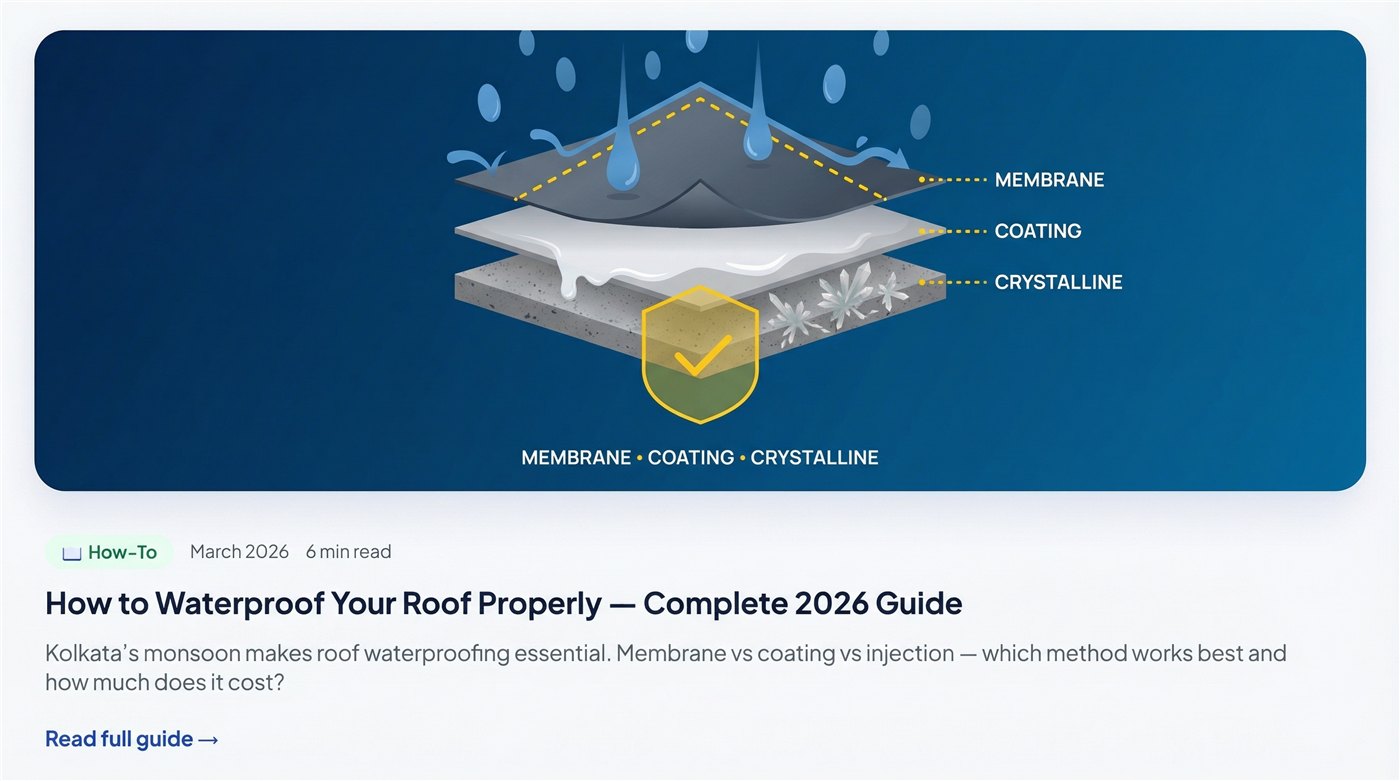
| Method | Cost (per sq.ft.) | Life | Best For |
|---|---|---|---|
| Bituminous membrane | ₹60–₹90 | 10–15 years | Flat RCC roofs |
| Cementitious coating | ₹25–₹45 | 5–8 years | Toilets, terraces, basements |
| Liquid applied membrane | ₹50–₹80 | 8–12 years | Complex shapes, parapet walls |
| Crystalline waterproofing | ₹70–₹100 | Lifetime | Water tanks, basements |
| Chinese tiles (Madras terrace) | ₹35–₹55 | 15–20 years | Traditional Kolkata roofs |
Step-by-Step Roof Waterproofing Process
- Inspect and repair: Fill all cracks with polymer-modified mortar. Allow to cure for 3–5 days.
- Clean thoroughly: Remove dust, laitance, and any oil. A clean surface is essential for adhesion.
- Apply primer: Bituminous primer for membrane systems; bonding agent for cementitious systems.
- Apply waterproofing: Follow manufacturer specification — number of coats, wet film thickness, overlap at joints.
- Protect the waterproofing: A protective screed or tiles prevents UV damage and foot traffic damage to the membrane.
- Check drainage: Ensure rainwater outlets are clear and sloped correctly — minimum 1:80 fall.
💡 Kolkata-specific tip: Treat parapet wall joints and slab-to-parapet junctions as a priority — these are the most common entry points for water in Kolkata homes.
Find Waterproofing Material Dealers Near You
Dr. Fixit, Pidilite, STP and more — sourced from verified dealers in your Kolkata zone.