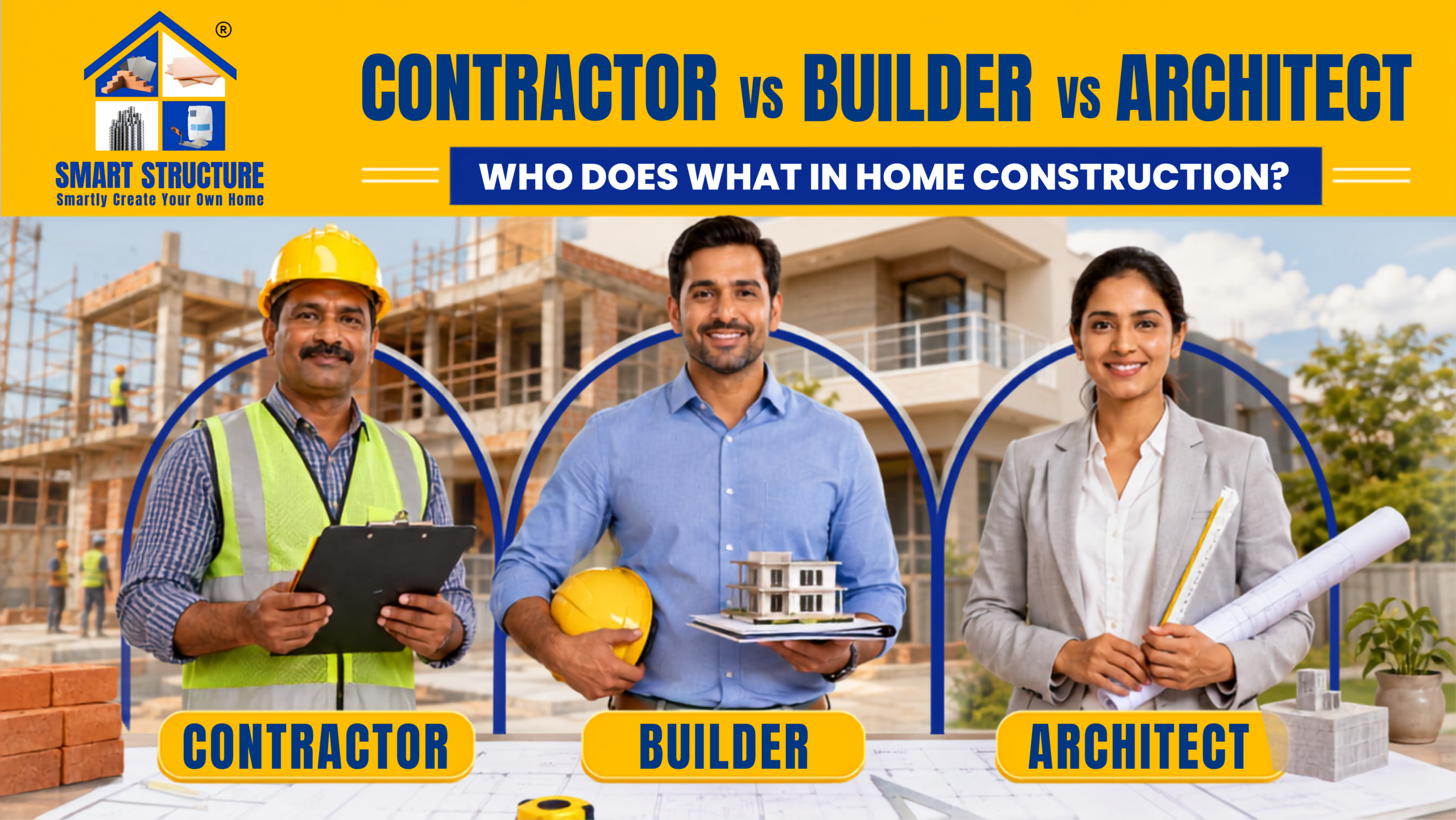
Planning a house involves more than selecting cement, TMT bars, bricks, tiles and paint. You also need the right professionals to design, manage and execute the construction.
Many homeowners begin with questions such as:
- “Ghar banane ke liye architect ya contractor?”
- “Should I hire a builder or contractor?”
- “Who will prepare my ghar ka naksha?”
- “Can one person manage the complete construction?”
- “What is the difference between a builder and a thekedar?”
An architect, contractor and builder may all be connected with construction, but they do not perform the same job. Their responsibilities, fees and level of involvement can differ significantly.
Understanding contractor vs builder vs architect will help you select the right professional, define responsibilities clearly and avoid costly misunderstandings during construction.
Contractor vs Builder vs Architect: Quick Comparison
Architect
An architect plans and designs the house. They help convert your requirements into practical drawings and coordinate the overall design.
Contractor
A contractor executes the construction work according to the approved architectural and structural drawings.
Builder
A builder generally manages the development and delivery of an entire house, building or real estate project.
The roles may overlap in some businesses. Therefore, the actual scope should always be confirmed through a written agreement.
What Does an Architect Do?
An architect is responsible for planning how the house will look, function and use the available space.
Before preparing the design, the architect may study:
- Plot size and orientation
- Family requirements
- Number and size of rooms
- Natural light and ventilation
- Privacy and circulation
- Parking requirements
- Local building regulations
- Construction budget
- Future expansion requirements
Based on these details, the architect may prepare:
- Conceptual layouts
- Floor plans
- Elevations
- Sections
- Door and window schedules
- Material and finish suggestions
- Working drawings
- Coordination drawings
An architect may also coordinate with structural engineers, plumbing consultants, electrical consultants and other specialists.
In India, the title of “Architect” is protected under the Architects Act, 1972. A professional using this title should be registered with the Council of Architecture. Homeowners can verify registration through the Council of Architecture.
When searching for an architect near me or someone to prepare a ghar ka naksha, check their registration, design approach, previous projects and experience with similar plots.
What Does a Contractor Do?
A contractor is mainly responsible for executing the work at the construction site.
The contractor uses the architect’s drawings and the structural engineer’s specifications to organise labour, materials and daily construction activities.
Depending on the agreement, a contractor may handle:
- Site preparation
- Excavation and foundation work
- Reinforcement and concrete work
- Brickwork and plastering
- Flooring and tile installation
- Plumbing and electrical coordination
- Painting and finishing
- Labour management
- Material procurement
- Equipment and machinery
- Work scheduling
- Daily site supervision
Contractors may follow different working models.
Labour Contractor
A labour contractor provides workers and manages labour-related activities. The homeowner purchases the building materials separately.
Labour-and-Material Contractor
The contractor supplies both labour and specified materials. The quotation should clearly mention brands, grades, quantities and exclusions.
Turnkey Contractor
A turnkey contractor may handle most of the construction process and deliver the house in an agreed condition. The exact meaning of “turnkey” can vary, so every included and excluded item must be documented.
When searching for a contractor near me, thekedar near me or turnkey contractor near me, do not select someone based only on the lowest quotation.
What Does a Builder Do?
A builder usually takes broader responsibility for developing and delivering a complete property or real estate project.
Depending on the project, a builder may:
- Acquire or develop land
- Arrange project approvals
- Appoint architects and engineers
- Hire contractors
- Arrange project finance
- Manage construction
- Coordinate marketing and sales
- Deliver flats or houses to buyers
- Manage common facilities
In real estate projects, the builder or developer generally sells completed or under-construction apartments, houses or plots to customers.
Some companies also offer to build individual homes on the customer’s land. In such cases, the builder’s services may appear similar to those of a turnkey contractor.
If you are purchasing a property from a builder in West Bengal, check the available promoter, project and registration details.
Builder vs Contractor: What Is the Main Difference?
The words builder and contractor are often used interchangeably, but their normal responsibilities are different.
A contractor is generally hired by a homeowner, builder or organisation to execute a defined scope of construction work.
A builder usually manages the complete development and delivery of a property. The builder may hire separate contractors to execute different parts of the project.
For example:
- A builder develops an apartment complex.
- An architect designs the project.
- A structural engineer designs the structural system.
- Contractors execute civil, electrical, plumbing and finishing work.
For an independent house, the homeowner may directly appoint an architect and contractor without involving a builder.
Architect vs Contractor: What Is the Difference?
An architect focuses primarily on planning and design, while a contractor focuses on execution.
The architect decides how spaces should be arranged and prepares drawings that communicate the design.
The contractor uses those drawings to organise the construction work at the site.
A contractor should not make major changes to room sizes, structural elements or approved specifications without consulting the relevant architect or engineer.
Similarly, an architect may review the construction, but the contractor remains responsible for labour management and daily execution unless the agreement states otherwise.
Where Does the Structural Engineer Fit In?
A structural engineer is another essential professional whose role should not be confused with that of an architect or contractor.
The structural engineer designs and specifies important structural components such as:
- Foundations
- Columns
- Beams
- Slabs
- Reinforcement
- Structural connections
The engineer considers soil conditions, loads, spans, building height and structural safety before preparing the design.
A raj mistri or contractor may have valuable site experience, but important structural decisions should follow the approved structural drawings.
Who Should You Hire for Your House?
The right choice depends on the type of project.
If You Own a Plot and Want a Custom House
Start with a registered architect who can prepare the house design according to your plot, family requirements and budget.
You will also require a structural engineer and a contractor to execute the approved design.
If You Are Buying a Flat
You will mainly deal with the builder or developer. Review the project registration, specifications, payment schedule, completion timeline and agreement before purchasing.
If You Are Renovating Your Home
A contractor may be sufficient for basic painting, flooring, plumbing, electrical repairs or minor renovation.
For major layout changes, wall removal, extensions or structural alterations, consult an architect and structural engineer before starting.
If You Want One Company to Manage Everything
You may consider a turnkey contractor or design-and-build company.
Confirm whether the quotation includes:
- Architectural design
- Structural design
- Government approvals
- Labour
- Building materials
- Plumbing
- Electrical work
- Flooring
- Painting
- Doors and windows
- Sanitaryware
- Kitchen work
- Final cleaning
The phrase “complete construction” should never be accepted without a detailed scope.
What to Check Before Hiring
Whether you are searching for a builder near me, architect near me or house construction contractor near me, check the following before finalising anyone:
- Relevant experience
- Previous completed projects
- Professional registration where applicable
- Client references
- Detailed scope of work
- Material and labour responsibilities
- Brands and specifications
- Payment schedule
- Expected completion timeline
- Process for approving extra work
- Quality-control responsibility
- Warranty or defect-correction terms
- Site-safety responsibility
- Conditions for delay or cancellation
Always use a written agreement. Verbal promises can easily create disagreements after the work begins.
Questions to Ask an Architect
Before appointing an architect, ask:
- Are you registered with the Council of Architecture?
- Have you designed houses of a similar size?
- What drawings are included in your fee?
- Will you coordinate with the structural engineer?
- How many site visits are included?
- How will design changes be handled?
- Is approval-related assistance included?
- What is the expected design timeline?
Questions to Ask a Contractor
Before appointing a contractor, ask:
- Is the quotation for labour only or labour and materials?
- Which materials and brands are included?
- Who will supervise the site daily?
- How many workers will be available?
- What work is excluded?
- How will additional work be priced?
- What is the payment schedule?
- Who is responsible for removing construction waste?
- What happens if the work is delayed?
- Will bills and material records be provided?
Why Choose Smart Structure?
Finding suitable professionals and purchasing materials from separate sources can make construction difficult to coordinate.
Smart Structure helps simplify the journey by bringing building materials and construction professionals closer through one platform.
Homeowners, builders, contractors, architects and engineers can explore construction categories such as cement, TMT steel, bricks, sand, tiles, paint, electrical products, plumbing materials, sanitaryware, plywood, laminates and construction chemicals.
Through Find Mistri, users can also discover contractors, architects, engineers, electricians, plumbers, painters, mistris and other professionals near their preferred location.
Explore building materials and construction solutions on Smart Structure.
A Smart Hiring Checklist
Before starting construction:
- Finalise the design before requesting the construction quotation.
- Obtain structural drawings from a qualified engineer.
- Define the contractor’s scope in writing.
- Confirm who will purchase each material.
- Mention brands and specifications in the agreement.
- Use stage-wise payments linked to completed work.
- Record every approved change.
- Compare quotations using the same scope.
- Review construction progress regularly.
- Never approve structural changes informally.
- Keep invoices, drawings and payment records.
- Verify the professional’s previous work.
Final Thoughts
The difference between contractor vs builder vs architect becomes simple once you understand their primary responsibilities.
An architect plans and designs the house.
A contractor executes and manages the construction work.
A builder develops and delivers the complete property or project.
For a custom house on your own plot, you will usually need an architect, structural engineer and contractor working together. If you are purchasing a flat, you will mainly deal with the builder or developer.
Whether you need an architect near me, contractor near me, builder near me or thekedar near me, select the professional according to your actual requirement—not merely according to the lowest price.
Smart Structure helps connect the materials, dealers and professionals needed throughout the construction journey.
Choose the right professional, define the right scope and build your home with greater confidence.